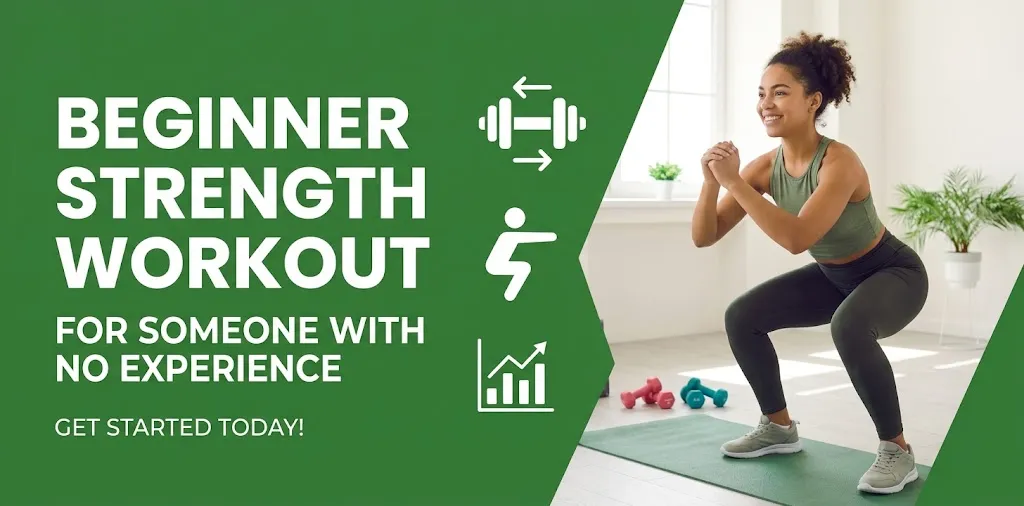
If you have never lifted weights or followed a strength program, you do not need a complicated gym routine. A beginner strength workout can start with simple movements such as squats, wall push-ups, rows, glute bridges, and planks. Begin with light resistance, focus on controlled form, and train your major muscle groups about two days per week. As the exercises become easier, slowly add repetitions, resistance, or sets.
Starting strength training can feel intimidating when you do not know what exercises to choose, how much weight to use, or what good form looks like. The good news is that your first workouts can be very simple.
You do not need to lift heavy weights, train every day, or spend hours in a gym. Your first goal is to learn the movements and build a routine you can repeat.
A Simple Beginner Strength Workout
For someone with no strength-training experience, a full-body workout is a practical place to start. It lets you practice the basic movement patterns without needing a large number of exercises.
Do this workout 2 days per week, leaving at least one day between strength sessions.
| Exercise | Beginner Version | Sets | Reps |
|---|---|---|---|
| Chair squat | Sit-to-stand from a sturdy chair | 1–2 | 8–12 |
| Wall push-up | Push against a wall | 1–2 | 8–12 |
| Glute bridge | Bodyweight | 1–2 | 8–12 |
| Resistance-band or light dumbbell row | Pull toward your body | 1–2 | 8–12 |
| Standing hip hinge | Practice with no weight | 1–2 | 8–12 |
| Bird dog | Hands and knees | 1–2 | 6–10 per side |
You can start with one set of each exercise. As you become comfortable with the movements, progress toward two sets.
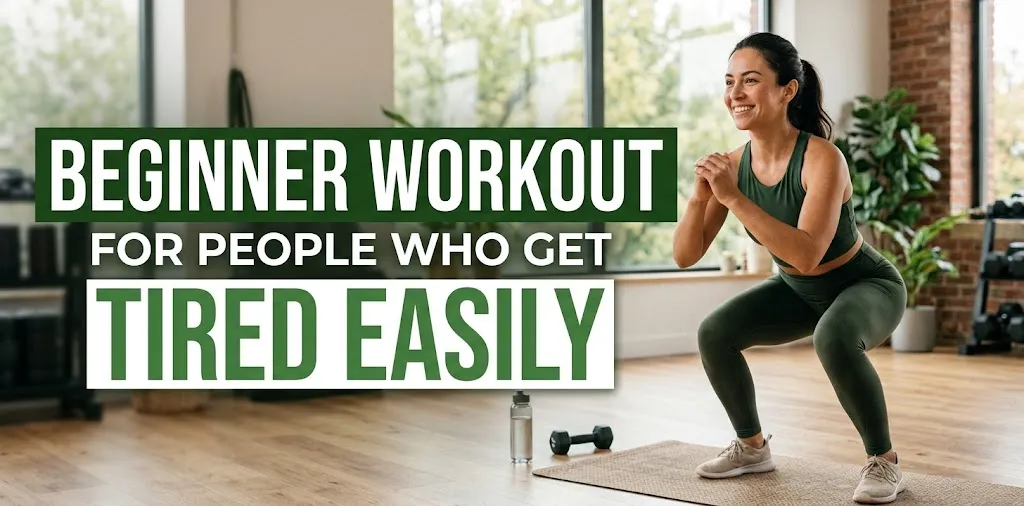
1. Chair Squat
Stand in front of a sturdy chair with your feet about shoulder-width apart.
Push your hips back and bend your knees as you lower yourself toward the chair. Lightly touch the chair, then stand back up.
Keep your chest comfortable and your feet planted on the floor.
Make it easier: Use a higher chair or place your hands on your thighs for support.
Make it harder later: Perform the squat without the chair, then add a light dumbbell.
2. Wall Push-Up
Stand facing a wall with your hands against it around chest height.
Step your feet back slightly. Bend your elbows and bring your chest toward the wall, then push yourself away.
Keep your body in a straight line rather than letting your hips move first.
Make it easier: Stand closer to the wall.
Make it harder: Move your feet farther away, then progress to an incline push-up on a sturdy elevated surface.
3. Glute Bridge
Lie on your back with your knees bent and your feet flat on the floor.
Press through your feet and gently raise your hips. Pause briefly at the top, then lower your hips with control.
Think about squeezing your glutes rather than trying to lift your hips as high as possible.
Make it harder later: Add more repetitions or eventually use light resistance.
4. Resistance-Band or Light Dumbbell Row
If you have a resistance band, anchor it securely according to its instructions. If you have dumbbells, use a light pair.
Pull your hands toward your ribs while keeping your shoulders controlled. Slowly return to the starting position.
This teaches a basic pulling movement that works the upper back and arms.
No equipment: You can postpone this exercise until you have a band or light dumbbells rather than trying to improvise with an unsafe household object.
5. Standing Hip Hinge
Stand with your feet about hip-width apart and your knees slightly bent.
Push your hips backward while keeping your back in a comfortable neutral position. Then squeeze your glutes and return to standing.
This movement helps you learn the basic pattern used in exercises such as deadlifts.
At first, practice the movement without weight. There is no need to rush into barbell deadlifts during your first workout.
6. Bird Dog
Start on your hands and knees.
Slowly extend one arm and the opposite leg while keeping your torso steady. Return them to the starting position and switch sides.
Move slowly rather than trying to lift your arm and leg as high as possible.
This exercise helps you practice controlled movement and trunk stability.
How to Start if You Have Never Exercised Before
The biggest mistake beginners make is treating their first workout like a fitness test.
Your first few sessions should feel like practice.
Use this progression:
- Learn the movement without resistance.
- Practice a few slow repetitions.
- Add a small amount of resistance only when the movement feels comfortable.
- Stop each set while you still feel you could perform another few good repetitions.
- Repeat the same basic exercises for several weeks.
- Increase the challenge gradually.
You do not need to test your maximum strength. The goal is to build control, confidence, and consistency.
How Much Weight Should a Beginner Lift?
There is no single starting weight that works for everyone.
The right weight is one that allows you to complete your planned repetitions with controlled technique while still making the final repetitions challenging.
For example, suppose you are doing 10 dumbbell rows. If your form starts breaking down by repetition six, the weight is probably too heavy. If you can perform 20 repetitions without much effort, it may be too light for your current goal.
For your first sessions, it is often better to start lighter than you think you need.
You can always increase the resistance later.
A Simple Rule for Choosing Resistance
Use a weight or resistance that feels manageable while you learn the exercise.
A range of 8–12 controlled repetitions is a practical starting point for many beginner strength exercises.
Do not worry about finding your one-repetition maximum. Testing how much you can lift for one maximum-effort repetition is unnecessary when you are just learning strength training.
How Often Should a Beginner Do Strength Training?
For most beginners, two full-body strength workouts per week are enough to establish a routine.
For example:
| Day | Activity |
|---|---|
| Monday | Full-body strength workout |
| Tuesday | Walking or rest |
| Wednesday | Light activity or rest |
| Thursday | Full-body strength workout |
| Friday | Walking or rest |
| Saturday | Optional easy activity |
| Sunday | Rest |
You can add walking or another enjoyable activity on the days between workouts. If you are currently inactive, build your activity level gradually rather than trying to reach a high target immediately.
What Should a Beginner Do Before the Workout?
You do not need a long warm-up.
Spend about 5–10 minutes preparing your body for movement. Start with easy activity such as walking, followed by a few gentle repetitions of the exercises you plan to perform.
For example:
- 3–5 minutes of easy walking
- 5 chair squats
- 5 wall push-ups
- 5 slow hip hinges
- A few gentle arm movements
The first repetitions of your actual exercises can also serve as preparation. If you are using resistance, start with a lighter load before your working sets.
How Hard Should a Beginner Workout Feel?
A beginner workout should be challenging without feeling like an all-out effort.
You should be able to maintain control throughout the movement. Your muscles may feel tired near the end of a set, but you should not need to sacrifice technique to finish the repetitions.
A useful beginner mindset is:
Practice first. Progress second.
You do not need to train until you cannot perform another repetition. Pushing too hard during your first sessions can leave you very sore and make it harder to establish a consistent routine.
How to Progress Without Getting Overwhelmed
Once your exercises feel comfortable, change only one thing at a time.
You can:
- Add 1–2 repetitions.
- Add a second set.
- Increase resistance slightly.
- Move to a harder version of the exercise.
- Improve your range of motion.
- Perform the same repetitions with better control.
For example, your chair squat progression might look like this:
Week 1: 1 set of 8 chair squats
Week 2: 1 set of 10 chair squats
Week 3: 2 sets of 8 chair squats
Week 4: 2 sets of 10 chair squats
Later: Progress to bodyweight squats
This is not a strict schedule. If a movement still feels difficult, stay at the easier level longer.
Bodyweight vs. Weights for Beginners
You do not need a gym membership to begin strength training.
Bodyweight exercises can provide resistance, while resistance bands, dumbbells, machines, and other equipment can be added as you gain experience.
| Starting Option | Best For | Main Advantage |
|---|---|---|
| Bodyweight | Complete beginners | Simple and inexpensive |
| Resistance bands | Home workouts | Easy to store and use |
| Dumbbells | Home or gym | Easy to progress gradually |
| Weight machines | New gym members | Guided movement path |
| Barbells | Later-stage beginners | Useful for heavier compound training |
If you have never trained before, there is no need to start with a barbell.
Learn the movement first. Add equipment when it helps you progress.
Two Realistic Ways to Start
Example 1: The Complete Beginner at Home
Imagine someone who has spent most of the past year sitting at a desk and has no exercise equipment.
Their first two weekly sessions could include chair squats, wall push-ups, glute bridges, hip hinges, and bird dogs.
They could also take short walks on several other days. After a few weeks, they might add a resistance band or light dumbbells.
The goal is not to finish an exhausting workout. The goal is to make the next workout easy to start.
Example 2: The Beginner Joining a Gym
Someone who has never used gym equipment may feel overwhelmed by barbells and machines.
Instead of trying everything, they could begin with a few simple machine or dumbbell exercises that cover the legs, pushing muscles, pulling muscles, and core.
A gym employee or qualified fitness professional can demonstrate equipment use and basic technique. A personal trainer can also help if you want individualized instruction.
Common Beginner Mistakes to Avoid
Starting Too Heavy
Heavy weights are not required to prove that your workout is effective.
Starting too heavy can make it difficult to learn proper movement and control. Choose a resistance that allows you to practice good technique.
Changing the Workout Every Session
Beginners often think they need new exercises constantly.
You usually learn faster by repeating a small group of movements. Repetition gives you a chance to become more comfortable with the technique and recognize your progress.
Training Every Day
Strength training does not need to happen seven days a week.
Give your muscles time between challenging sessions. Two full-body sessions per week can provide a strong starting point.
Chasing Soreness
Being extremely sore is not proof that you had a better workout.
A productive beginner workout can leave your muscles tired without making normal movement difficult the next day.
Ignoring Technique
If you cannot control the movement, reduce the resistance or choose an easier variation.
Good technique matters more than the number written on a dumbbell.
Comparing Yourself With Experienced Lifters
Someone who has trained for five years should not be your benchmark on day one.
Your best comparison is your own starting point.
When Should You Stop an Exercise?
Normal muscle effort is expected during strength training. Sharp, sudden, or unusual pain is different.
Stop the exercise if you experience significant pain, dizziness, unusual shortness of breath, or another concerning symptom.
If you have a chronic health condition, disability, existing injury, or another concern about what type of exercise is appropriate for you, talk with a healthcare professional or qualified exercise professional before increasing your activity.
Do You Need a Gym or Personal Trainer?
No.
You can start a useful strength routine at home with little or no equipment. A gym becomes useful when you want access to more resistance, machines, or a wider range of exercises.
A personal trainer can be helpful if you are unsure about technique, need accountability, or want individualized programming. It is not necessary for every beginner.
If you choose a trainer, look for someone with an appropriate professional certification and experience working with beginners.
What Results Can You Expect?
At first, progress may show up as better control and confidence rather than dramatic physical changes.
You may notice that:
- A chair squat feels easier.
- You can perform more controlled push-ups.
- A resistance band feels less challenging.
- Everyday tasks feel more manageable.
- You become more comfortable exercising.
- You can gradually use more resistance.
Strength training can also support physical function and make everyday movements easier as your strength improves.
Frequently Asked Questions
Can I start strength training if I have never exercised before?
Yes. Beginners can start with simple bodyweight movements and very light resistance. Focus on learning the exercises and increase the challenge gradually rather than trying to match experienced lifters.
How many days a week should a complete beginner lift weights?
Two strength-training days per week are a good starting point for many healthy adults. You can increase your training later as your fitness, recovery, and schedule allow.
Should beginners do weights or bodyweight exercises first?
Either can work. If you have no experience, bodyweight exercises or very light resistance can make it easier to learn movement before gradually adding bands, dumbbells, machines, or other resistance.
Start With Less Than You Think You Need
The best beginner strength workout is not the one that leaves you exhausted. It is the one that teaches you the basic movements, feels manageable, and makes you willing to come back for the next session.
Start with two short full-body workouts each week. Use simple exercises, keep the resistance light, and increase the challenge slowly as your technique and confidence improve.
Expert tip: Keep the same basic workout for several weeks instead of constantly searching for a new routine. When you can clearly see that the same exercises are becoming easier, you have a simple and useful measure of progress.