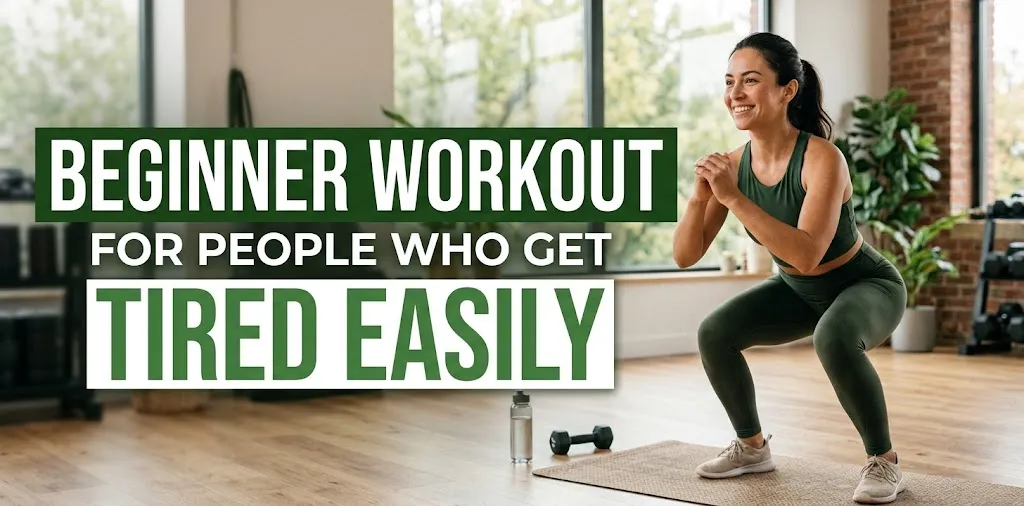
Getting tired quickly can make exercise feel harder than it needs to be. You may want to get stronger, improve your stamina, or simply feel better during daily activities, but a long workout can leave you exhausted.
The good news is that you do not need to start with hard cardio, heavy weights, or long gym sessions. A better approach is to begin with short, low-impact workouts and increase the amount slowly as your fitness improves.
What Is a Good Beginner Workout for People Who Get Tired Easily?
A good beginner workout for people who get tired easily combines gentle cardio, simple strength exercises, and enough rest to keep fatigue under control. Start with about 10–15 minutes of easy movement, such as walking, marching, wall push-ups, chair squats, and gentle stretching. Increase the time gradually instead of trying to exercise hard from day one.
The goal is not to finish exhausted. The goal is to finish feeling like you could have done a little more.
Why You May Get Tired So Quickly During Exercise
Getting tired quickly does not always mean you are out of shape. If you have been inactive, your body may simply need time to adjust to physical activity.
Other factors can also affect how exercise feels, including:
- Poor sleep
- Not eating enough before activity
- Dehydration
- Stress
- Exercising too hard or too fast
- Recovering from an illness
- Certain medications or health conditions
If fatigue is new, severe, persistent, or much greater than you would expect from a small amount of activity, talk with a healthcare professional before pushing yourself harder.
Your first workout should match your current ability, not the fitness level you hope to reach later.
The Best Types of Exercise When You Tire Easily
You do not need to run or perform intense circuits to build fitness. Low-impact activities are often a better starting point because you can control the pace and stop before you become overly fatigued.
Easy Walking
Walking is one of the simplest ways to begin.
Start with a comfortable pace. You should be able to speak in short sentences without struggling for breath. If 10 minutes feels like too much, split it into shorter walks during the day.
For example:
- 5 minutes in the morning
- 5 minutes after lunch
- 5 minutes in the evening
Small amounts count. You can gradually increase your activity as your stamina improves.
Marching in Place
Marching in place is useful when you want to exercise at home.
Keep your steps small and your pace comfortable. Hold onto a sturdy surface if you need extra balance.
Try:
- 30–60 seconds of marching
- 30–60 seconds of rest
- Repeat 3–5 times
Chair Squats
Chair squats strengthen your legs without requiring you to get down on the floor.
Stand in front of a sturdy chair with your feet about shoulder-width apart. Slowly bend your knees and hips as if you are going to sit down. Lightly touch the chair, then stand back up.
Start with 5–8 repetitions.
Wall Push-Ups
Wall push-ups are easier than floor push-ups and can help build upper-body strength.
Place your hands on a wall around chest height. Step back slightly, bend your elbows, bring your chest toward the wall, and push yourself back.
Start with 5–10 repetitions.
Glute Bridges
If getting on and off the floor is comfortable for you, glute bridges can strengthen your hips and lower body.
Lie on your back with your knees bent and feet flat. Tighten your abdominal muscles gently, press through your feet, and lift your hips a few inches. Lower slowly.
Start with 6–10 repetitions.
If getting onto the floor is difficult, skip this exercise and use chair-based exercises instead.
A 10-Minute Workout for People Who Get Tired Easily
You can start with this simple routine at home. No equipment is required.
| Exercise | Time or Reps |
|---|---|
| Easy marching | 2 minutes |
| Chair squats | 5–8 reps |
| Wall push-ups | 5–10 reps |
| Easy marching | 2 minutes |
| Standing calf raises | 8–10 reps |
| Gentle stretching | 2 minutes |
Move slowly and rest whenever you need to.
You do not have to complete every exercise without stopping. For someone with low fitness, taking a short break is part of the workout—not a failure.
A Simple 4-Week Plan
The easiest way to improve stamina is to give your body time to adapt.
Week 1: Get Used to Moving
Exercise 3 days this week.
Keep each session around 10 minutes.
Focus on:
- Easy walking or marching
- Chair squats
- Wall push-ups
- Gentle stretching
Your main goal is simply to finish each session without becoming overly tired.
Week 2: Add a Little More
Exercise 3–4 days this week.
Aim for about 12–15 minutes per session.
You can add a few minutes of walking or one extra set of an easy strength exercise if you feel ready.
Week 3: Build Your Endurance
Exercise about 4 days this week.
Aim for 15–20 minutes per session.
Try slightly longer periods of walking or marching while keeping the intensity comfortable.
Week 4: Create a Routine
Exercise 4–5 days this week, depending on how well you recover.
Aim for roughly 20 minutes on most active days.
You can begin adding more strength work while keeping at least some sessions easy.
Do not increase the workout just because the calendar says you should. If a previous week still feels difficult, repeat it.
How Hard Should You Exercise?
When you get tired easily, intensity matters more than trying to hit a specific speed or distance.
A simple test is the talk test.
During easy-to-moderate activity, you should be able to talk. If you are struggling to speak because you are breathing too hard, slow down or take a break.
You can also use a simple 0–10 effort scale:
- 0–2: Very easy
- 3–4: Easy
- 5–6: Moderate
- 7–8: Hard
- 9–10: Very hard
For your first workouts, staying mostly around the easy-to-moderate range is reasonable.
You do not need to train until you are completely exhausted to make progress.
How Much Exercise Should You Eventually Do?
A common long-term goal for adults is 150–300 minutes of moderate-intensity aerobic activity per week, plus muscle-strengthening activity on at least 2 days per week.
But that is a long-term target, not a requirement for your first week.
If you are currently inactive, starting with 5, 10, or 15 minutes can be a much more practical approach. You can build toward longer sessions as your fitness improves.
Think of the process like this:
Start small → recover well → repeat → add a little → repeat.
That is more useful than forcing yourself through a workout your body is not ready for.
How to Avoid Getting Exhausted During Your Workout
A few simple changes can make beginner workouts much easier to manage.
Slow Down
One of the most common mistakes is starting too fast.
If you begin walking at a pace that makes you breathe heavily within a few minutes, slow down. Building endurance requires repeated practice, not one extremely difficult workout.
Take Planned Breaks
You do not have to wait until you are completely exhausted before resting.
For example, try:
2 minutes movement → 1 minute rest → 2 minutes movement.
Over time, you can make the movement periods longer and the rest periods shorter.
Keep the First Few Workouts Short
A 10-minute workout that you can repeat consistently is more useful than a 45-minute workout that leaves you too tired to exercise again for several days.
Avoid Training to Failure
Beginners do not need to perform every strength exercise until they physically cannot complete another repetition.
Stop while you still feel that you could perform a few more controlled repetitions.
Give Yourself Recovery Days
Your body needs time to adjust to a new exercise routine.
You can still move on recovery days by taking an easy walk or doing gentle mobility work, but you do not need a hard workout every day.
What If You Get Tired After Just 5 Minutes?
Do not assume that you need to push through it.
Instead, reduce the workload.
For example, try:
- 2 minutes walking
- 1–2 minutes sitting or standing rest
- 2 minutes walking
- 1–2 minutes rest
- 2 minutes walking
You can gradually increase the movement periods as they become easier.
Even a small amount of physical activity is a useful starting point when you have been inactive.
Two Realistic Beginner Examples
Example 1: Someone Who Gets Winded Easily
Imagine someone who has spent most of the past year sitting at a desk and rarely exercising.
Instead of starting with jogging, they could begin with 5–10 minutes of easy walking three days per week. They could add wall push-ups and chair squats after walking.
After a few weeks, if the workouts feel easier and recovery is good, they could slowly extend the walking time.
The important part is that the workout starts below their maximum effort.
Example 2: Someone Who Can Walk but Gets Tired With Strength Training
Another beginner may be comfortable walking for 15 minutes but become tired quickly when doing several strength exercises.
They could separate the sessions:
- Monday: 15-minute easy walk
- Tuesday: 10-minute strength session
- Wednesday: Rest or gentle movement
- Thursday: 15-minute walk
- Friday: 10-minute strength session
- Weekend: Easy activity or rest
This approach prevents every workout from becoming a demanding full-body session.
When Tiredness Means You Should Stop
Normal exercise fatigue usually improves after you slow down or rest. Certain symptoms should not be treated as something you simply need to push through.
Stop exercising if you experience concerning symptoms such as chest pain, severe shortness of breath, fainting, or significant dizziness.
If you regularly become unusually short of breath with very little activity, or you have unexplained fatigue or other concerning symptoms, talk with a healthcare professional before increasing your workout.
People with known medical conditions, recent injuries, or other health concerns may also benefit from getting individual exercise guidance.
Common Mistakes That Make Beginners More Tired
Starting With HIIT
High-intensity interval training can be useful for some people, but it is not necessary when you are just beginning and tire easily.
Start with easier movement first.
Trying to Copy Someone Else’s Workout
A workout that is appropriate for a fit person may be far too difficult for someone who is starting from a low fitness level.
Your starting point should be based on your current ability.
Doing Too Much Too Soon
Adding a large amount of exercise overnight can leave you extremely sore and tired.
Small increases are easier to recover from.
Ignoring Recovery
If you feel exhausted every day after exercising, your routine may be too demanding.
Recovery is part of training.
Focusing Only on Cardio
Walking is a great starting point, but strength work matters too. Simple exercises such as wall push-ups and chair squats can help build the muscles you use for everyday activities.
What to Do When You Start Feeling Fitter
Once your current routine feels manageable, change only one thing at a time.
You might:
- Add 2–5 minutes to a walk
- Add a few repetitions
- Add another easy workout day
- Reduce rest periods slightly
- Walk a little faster
- Add a light resistance band
Do not increase everything at once.
For example, if you currently walk for 15 minutes three times a week, you might increase one walk to 18–20 minutes rather than immediately adding more speed, distance, and workout days.
Frequently Asked Questions
Is it okay to exercise if I get tired very quickly?
Yes, if your tiredness is simply related to being inactive and you can exercise comfortably. Start with a small amount of low-intensity activity and increase gradually, but speak with a healthcare professional if your fatigue is unexplained, severe, persistent, or accompanied by concerning symptoms.
What is the easiest exercise for someone with low stamina?
Easy walking is one of the simplest options because you can control the pace and duration. Marching in place, chair exercises, and wall push-ups are also useful choices when you want a simple home workout.
How long should a beginner workout if they get tired easily?
There is no single perfect duration. Starting with 5–15 minutes can be reasonable for someone who is very inactive, and you can gradually build toward longer sessions as your stamina improves. The key is to increase activity gradually rather than forcing a long workout immediately.
Start Smaller Than You Think You Need
If you get tired easily, your first goal should not be to complete a difficult workout. Your goal is to create a routine your body can handle and repeat.
Start with a short walk, a few chair squats, some wall push-ups, and gentle movement. Rest when needed. As those sessions become easier, add a little time or a few more repetitions.
A useful rule is simple: finish your workout feeling challenged, not destroyed. Consistent, manageable exercise can give you a much better foundation for building stamina than pushing yourself too hard at the beginning.