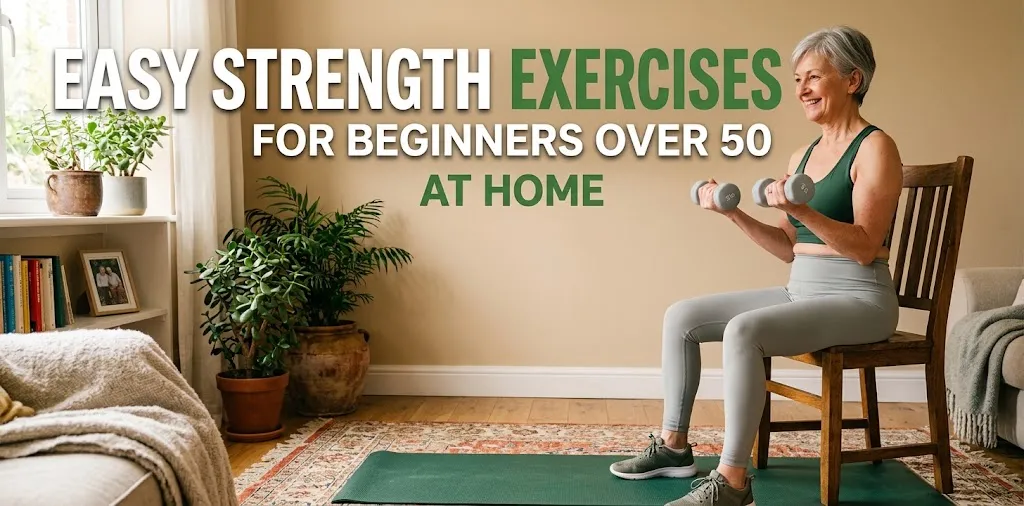
Getting stronger after 50 does not require a gym, heavy weights, or difficult workouts. Simple movements such as chair squats, wall push-ups, seated leg extensions, and resistance-band exercises can help you build strength at home while supporting everyday activities. The key is to start at a comfortable level, use good form, and increase the challenge gradually.
Why Strength Training Matters After 50
Strength training can help older adults maintain muscle strength, support balance, and make everyday movements easier. Activities such as getting out of a chair, climbing stairs, carrying groceries, and lifting household items all require strength.
For adults 65 and older, health guidelines recommend muscle-strengthening activity on at least two days each week, along with aerobic and balance activities. The same basic approach can be useful for adults over 50 who are beginning or returning to exercise.
You do not need to start with weights. Body-weight movements, a sturdy chair, a wall, or light resistance bands can provide enough resistance for a beginner.
8 Easy Strength Exercises for Beginners Over 50
The best starting exercises are simple, controlled movements that train the major muscle groups without requiring complicated equipment.
1. Chair Squats
Chair squats are one of the most useful exercises for building lower-body strength.
How to do them:
- Stand in front of a sturdy chair with your feet about hip-width apart.
- Hold your arms forward or keep them near your sides.
- Slowly bend your knees and push your hips backward.
- Lower yourself toward the chair.
- Lightly touch the chair with your hips.
- Press through your feet to stand.
Start with 6–10 repetitions.
If a full squat feels difficult, use a higher chair or place a cushion on the seat. As you become stronger, try standing without using your hands.
2. Wall Push-Ups
Wall push-ups work the chest, shoulders, and arms while being easier than floor push-ups.
How to do them:
- Stand facing a wall.
- Place your hands on the wall around shoulder height.
- Step back slightly.
- Keep your body straight.
- Bend your elbows and slowly bring your chest toward the wall.
- Push gently away from the wall.
Try 8–12 repetitions.
Keep the movement slow rather than trying to complete the exercise quickly.
3. Seated Knee Extensions
This seated exercise targets the muscles at the front of your thighs.
How to do them:
- Sit tall in a sturdy chair.
- Keep both feet on the floor.
- Slowly straighten one knee.
- Pause briefly at the top.
- Lower your foot with control.
- Repeat with the other leg.
Start with 8–12 repetitions per leg.
You can begin without any weight. Later, if the movement becomes easy, you can gradually add appropriate resistance.
4. Glute Bridges
Glute bridges strengthen the muscles around your hips and buttocks while you are lying on the floor.
How to do them:
- Lie on your back with your knees bent.
- Keep your feet flat on the floor.
- Place your arms comfortably at your sides.
- Tighten your abdominal muscles gently.
- Lift your hips slowly.
- Pause for a moment.
- Lower your hips with control.
Try 8–12 repetitions.
If getting down to or up from the floor is difficult, skip this exercise for now and use chair-based exercises instead.
5. Standing Calf Raises
Calf raises are simple and can also help you practice controlled standing movement.
How to do them:
- Stand behind a sturdy chair or near a countertop.
- Hold it lightly for support.
- Slowly raise your heels until you are on your toes.
- Pause briefly.
- Slowly lower your heels.
Start with 8–12 repetitions.
Do not rush the movement. Keep your weight balanced between your feet.
6. Seated or Standing Biceps Curls
Biceps curls strengthen the front of the upper arms.
You can do them seated or standing.
How to do them:
- Hold a light dumbbell in each hand.
- Keep your elbows close to your body.
- Bend your elbows and bring your hands toward your shoulders.
- Slowly lower the weights.
- Repeat without swinging your arms.
Start with a very light weight. If you do not have dumbbells, you can begin with no weight and practice the movement first.
7. Resistance-Band Rows
A resistance band can provide a simple way to work the upper back and arms.
How to do them:
- Sit or stand tall.
- Hold the resistance band securely.
- Pull your hands toward your body.
- Keep your elbows close to your sides.
- Squeeze your shoulder blades gently.
- Slowly return to the starting position.
Try 8–12 controlled repetitions.
Make sure the band is securely anchored and inspect it for damage before using it.
8. Standing Hip Abductions
This movement works muscles around the hips and can be performed while holding a sturdy support.
How to do them:
- Stand tall behind a sturdy chair.
- Hold the chair with one or both hands.
- Slowly move one leg out to the side.
- Keep your toes pointing forward.
- Return your leg to the starting position.
- Repeat on the other side.
Start with 8–12 repetitions per side.
Avoid leaning your upper body to the opposite side.
A Simple Beginner Routine
You do not need to perform every exercise in one session. A short routine can be enough when you are starting.
Try this beginner workout two days per week, with a rest day between strength sessions:
| Exercise | Starting Amount |
|---|---|
| Chair squats | 6–10 reps |
| Wall push-ups | 8–12 reps |
| Seated knee extensions | 8–12 per leg |
| Calf raises | 8–12 reps |
| Biceps curls | 8–12 reps |
| Resistance-band rows | 8–12 reps |
| Standing hip abductions | 8–12 per side |
Begin with one set of each exercise. You can gradually work toward two or three sets as your strength improves.
You do not need to push yourself to exhaustion. Your goal at first is to learn the movements, build confidence, and create a routine you can repeat consistently.
How Hard Should Exercise Feel?
For beginners over 50, the workout should feel challenging without feeling overwhelming.
A useful goal is to finish a set feeling that you could still perform another repetition with good form. As your strength improves, gradually increase the number of repetitions, resistance, or sets rather than making large jumps.
A simple progression might look like this:
Week 1: One set with easy resistance
Week 2: One set with slightly more repetitions
Week 3: One set with slightly more resistance if the exercises feel easy
Week 4: Consider adding a second set to selected exercises
There is no need to follow this schedule exactly. Your starting point should depend on your current fitness and how your body responds.
How to Make Home Strength Exercises Easier
If you have been inactive for a while, some standard exercises may feel too difficult. That does not mean you cannot strength train.
Try these modifications:
- Use a wall instead of the floor for push-ups.
- Use a higher chair for squats.
- Perform leg exercises while seated.
- Hold a sturdy support during standing exercises.
- Start without weights.
- Use lighter resistance bands.
- Reduce the number of repetitions.
- Take longer rest periods between exercises.
The goal is to find a version of the movement that you can perform safely and with control.
How to Make the Exercises Harder
Once your current routine feels easy, increase the challenge gradually.
You can:
- Add a few repetitions.
- Add another set.
- Use slightly heavier dumbbells.
- Move to a stronger resistance band.
- Slow down the lowering portion of an exercise.
- Progress from wall push-ups toward a higher-angle push-up.
- Reduce your dependence on the chair during squats when you can stand safely without it.
Do not increase several variables at the same time. Making one small change makes it easier to see how your body responds.
A 20-Minute At-Home Workout for Beginners
If you want a simple routine without complicated planning, try this structure:
Warm-up — 3 to 5 minutes
Walk around your home at an easy pace. Move your shoulders gently and perform a few comfortable knee bends.
Strength work — about 12 minutes
Complete one set of:
- Chair squats
- Wall push-ups
- Seated knee extensions
- Resistance-band rows
- Calf raises
- Biceps curls
Rest when needed.
Cool-down — 2 to 3 minutes
Walk slowly and allow your breathing to return toward normal. Gentle movements can help you transition out of the workout.
As you get stronger, you can gradually increase the amount of work.
What Equipment Do You Need?
You can begin with almost no equipment.
A good starter setup may include:
- A sturdy chair
- A clear exercise area
- Comfortable clothing
- Supportive shoes
- A light pair of dumbbells
- A light resistance band
You do not need a home gym. Body-weight movements and everyday household items can provide resistance, while dumbbells and resistance bands can be added as your fitness improves.
The chair should be stable and should not slide easily across the floor.
Strength Training Is Only One Part of Fitness After 50
Strength exercises are important, but they are not the only type of physical activity worth doing.
Adults 65 and older are generally advised to include aerobic activity, muscle-strengthening activity, and balance exercises each week. A common goal is at least 150 minutes of moderate aerobic activity per week, along with muscle-strengthening activity on at least two days and balance activities.
For someone over 50 who is starting from a low fitness level, that does not mean trying to reach the full target immediately.
A realistic week might include:
- Monday: Strength workout
- Tuesday: Easy walk
- Wednesday: Rest or light movement
- Thursday: Strength workout
- Friday: Easy walk
- Saturday: Balance or gentle activity
- Sunday: Rest or light walking
If that feels like too much, start with less and build gradually.
Two Realistic Ways to Start
If You Have Been Mostly Inactive
Imagine you spend most of your day sitting and have not exercised regularly for several months.
Instead of beginning with a demanding workout, start with chair squats, wall push-ups, seated knee extensions, and short walks. Keep the first sessions easy enough that you can focus on technique.
After a few weeks, you may be ready to add light resistance or another set.
If You Already Walk but Feel Weak
Walking is useful, but it does not replace all strength work.
If you can comfortably walk for 20–30 minutes but struggle to get up from a low chair or carry groceries, add two short strength sessions each week. Focus on squats or sit-to-stands, upper-body pushing and pulling, and hip and leg exercises.
This gives your routine a better balance of endurance and strength.
Common Mistakes to Avoid
Starting With Too Much Weight
Heavy weights are not necessary for your first workout. Starting too heavy can make it harder to maintain good form and may increase the chance of overdoing the exercise.
Start light and increase resistance gradually.
Moving Too Quickly
Strength exercises should be controlled. Jerking, swinging, or rushing through repetitions can make the movement harder to control.
Use smooth, steady movements during each exercise.
Holding Your Breath
Remember to breathe during each repetition. Avoid holding your breath while lifting or lowering the resistance.
Training the Same Muscles Every Day
Your muscles need time to recover. If you perform a full-body strength workout, leave recovery time before working those same major muscle groups again.
Ignoring Pain
Normal muscle effort is different from sharp or concerning pain.
Stop the exercise if you develop pain, dizziness, unusual shortness of breath, or another concerning symptom. If you have questions about exercising with a health condition or injury, talk with your health care professional.
How to Exercise More Safely at Home
Before starting, clear the area around you. Remove loose rugs, cords, or other objects that could cause you to trip.
Use a stable chair or countertop for support during standing exercises. Keep your movements controlled and avoid exercises that make you feel unstable.
If you have a chronic health condition, an injury, significant joint problems, or other concerns about starting exercise, talk with your health care professional about which activities are appropriate for you.
If you have been inactive for a long time, starting with low-intensity exercise and gradually building up is a better approach than suddenly attempting a hard workout.
How Often Should Beginners Over 50 Do Strength Exercises?
For most beginners, two strength-training days per week is a practical starting goal. Work the major muscle groups and allow recovery between sessions.
The important part is not trying to do everything at once. Consistent, manageable workouts are more useful than an intense session followed by several weeks without exercise.
Frequently Asked Questions
What are the easiest strength exercises for beginners over 50?
Chair squats, wall push-ups, seated knee extensions, calf raises, and light biceps curls are good starting choices. They require little equipment and can be modified to match your current strength.
Can you build muscle after 50 with home exercises?
Yes. Adults can improve strength through resistance exercises as they age. Body-weight movements, resistance bands, and light weights can all provide resistance, while gradually increasing the challenge can help you continue making progress.
How many days a week should a beginner over 50 do strength training?
Two days per week is a good general starting target, with recovery between sessions for the same muscle groups. If you have health conditions or significant limitations, your appropriate schedule may be different, so consider getting individualized guidance.
Start Small and Build From There
You do not have to become strong in a few workouts. Start with movements you can perform comfortably, such as chair squats and wall push-ups, then slowly add repetitions or resistance as they become easier.
For someone over 50, the most useful home routine is one that is safe enough to repeat and simple enough to maintain. Start with two short strength sessions each week, pay attention to your form, and give your body time to adapt. Over time, those small sessions can make everyday movements feel easier and help you stay active and independent.