Walking into a gym for the first time can feel harder than the workout itself. You may worry about using the wrong machine, lifting too little, looking awkward, or being judged by other people. The good news is that you do not need to feel confident before you start. You can build confidence by making your first workouts simple, short, and predictable.
This guide gives you a beginner workout you can follow without wandering around the gym wondering what to do next. It also explains how to make the gym feel less intimidating, what equipment to use first, and how to progress without rushing.
Start With a Simple Goal: Get Comfortable
If the gym makes you nervous, your first goal should not be lifting heavy weights or completing a long workout. Your first goal is to become comfortable being there.
Gym anxiety often comes from uncertainty. You may not know where the equipment is, how a machine works, what weight to choose, or what other people expect from you. Planning your workout before you arrive can remove much of that uncertainty.
For your first few visits, aim to:
- Learn where the main equipment is.
- Use a few easy-to-understand machines.
- Keep your workout short.
- Focus on learning movements rather than impressing anyone.
- Leave the gym feeling like you could come back again.
You are not taking a fitness test. You are learning a new environment.
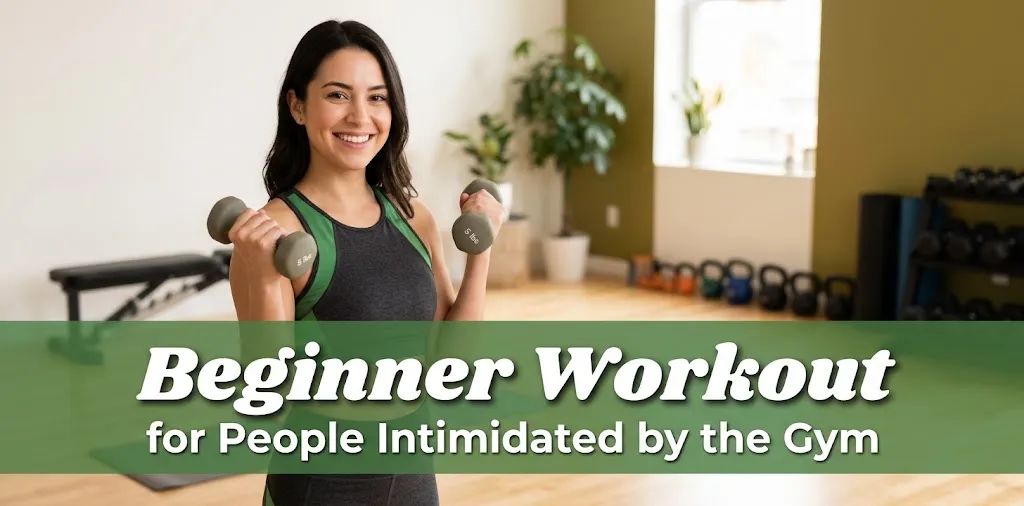
A Beginner Workout for People Intimidated by the Gym
A good first gym workout can take about 30–40 minutes. Start with 5–10 minutes of easy cardio, then perform a few simple full-body strength exercises. Choose a weight that lets you maintain controlled form and finish the set without straining to complete the final repetition.
| Exercise | Sets | Reps | Beginner Focus |
|---|---|---|---|
| Treadmill walk or stationary bike | 1 | 5–10 min | Easy warm-up |
| Leg press | 2 | 8–12 | Controlled movement |
| Seated chest press | 2 | 8–12 | Comfortable weight |
| Lat pulldown | 2 | 8–12 | Pull smoothly |
| Seated leg curl | 2 | 8–12 | Slow repetitions |
| Seated cable or machine row | 2 | 8–12 | Keep shoulders controlled |
| Easy treadmill walk | 1 | 5 min | Cool down |
You do not need to complete every exercise on your first visit. If six strength exercises feel like too much, choose three or four and finish while you still feel good.
1. Warm Up for 5–10 Minutes
Start with an easy treadmill walk, stationary bike, or elliptical.
The goal is not to make yourself tired. Use a pace that allows you to breathe comfortably and get familiar with the gym.
This is also a good time to look around. Notice where the water fountain, restrooms, stretching area, and machines are located.
2. Leg Press
The leg press is often easier for beginners to understand than a barbell squat because the machine guides the movement.
Start with a very light resistance. Sit with your back against the pad and place your feet where the machine instructions recommend. Lower the platform under control and press it away without locking your knees aggressively.
Perform 2 sets of 8–12 repetitions.
If you are unsure how to adjust the seat or machine, ask a gym employee. You are not expected to know how every machine works.
3. Seated Chest Press
The chest press works the muscles of your chest, shoulders, and arms.
Adjust the seat so the handles are around a comfortable chest height. Start with a light weight and press the handles forward without jerking.
Perform 2 sets of 8–12 repetitions.
Your first session is about learning the movement. There is no benefit to choosing a weight that makes you struggle just because someone nearby is lifting more.
4. Lat Pulldown
The lat pulldown trains your upper back and arms.
Sit down, secure your legs under the pads, and pull the bar toward your upper chest. Keep the movement controlled rather than swinging your body backward.
Perform 2 sets of 8–12 repetitions.
If you are confused by the setup, look for the diagram on the machine or ask an employee to show you how to adjust it.
5. Seated Leg Curl
The seated leg curl focuses on the muscles on the back of your thighs.
Set the machine according to its instructions and use a light resistance. Move slowly and avoid using momentum.
Perform 2 sets of 8–12 repetitions.
6. Seated Row
The seated row gives you another simple way to train your back.
Sit tall, hold the handles, and pull them toward your body while keeping your movement controlled. Avoid shrugging your shoulders toward your ears.
Perform 2 sets of 8–12 repetitions.
7. Finish With an Easy Walk
End with about five minutes of easy walking if you feel comfortable.
Then your workout is done.
You do not need to stay for an hour just because other people are spending more time in the gym.
How Heavy Should a Beginner Lift?
Choose a weight that feels manageable and allows you to use good control throughout the set.
A useful beginner rule is to stop before your muscles are completely exhausted. You should feel that you could have performed a few more good repetitions if necessary.
For your first few workouts, prioritize:
- Smooth repetitions
- Controlled movement
- Comfortable breathing
- Learning the equipment
- Consistent workouts
Do not worry about finding your maximum weight.
As the exercises become easier, you can gradually increase resistance. Progress should be earned through consistent practice rather than forced during your first week.
What If You Are Too Nervous to Do the Full Workout?
You can make the workout smaller.
For example, your first gym visit could simply be:
- Walk on the treadmill for 10 minutes.
- Try one strength machine.
- Spend a few minutes learning where things are.
- Leave.
That counts.
On your next visit, add another machine. The goal is to make the gym less unfamiliar.
Starting slowly can help you build confidence without creating unnecessary pressure.
Make Your First Gym Visit Easier
Visit During a Quieter Time
A crowded gym can make an unfamiliar place feel even more overwhelming.
If possible, try visiting during a less busy period. You may have more space to learn the equipment without feeling rushed.
You can also ask the front desk when the facility is usually quieter.
Walk Through the Gym Before Exercising
If you have never been there before, take a few minutes to explore.
Find:
- Cardio machines
- Weight machines
- Free weights
- Stretching areas
- Restrooms
- Water fountains
- Locker rooms
- Staff or help desks
You do not have to exercise immediately.
A short orientation can make your next visit much easier because fewer things will feel unknown.
Write Your Workout Down
Do not rely on memory when you are nervous.
Put your workout in your phone before you arrive:
Warm-up → Leg press → Chest press → Lat pulldown → Leg curl → Row → Cool down
Then simply work through the list.
This removes one of the biggest beginner problems: standing in the middle of the gym wondering what to do next.
Bring a Friend
A friend can make the first few visits less stressful.
Ideally, choose someone who makes you feel comfortable rather than someone who will pressure you to lift heavier or work harder.
You do not even need a fitness expert. Having another person beside you can make an unfamiliar environment feel easier to handle.
Use Headphones If They Help
Music or a podcast can help you focus on your own workout.
Just keep the volume low enough to remain aware of your surroundings and hear important instructions.
Ask Staff for Help
Asking a gym employee how to adjust a machine is normal.
Try a simple question such as:
“I’m new here. Could you show me how to set this machine up?”
That one question can save you from guessing and may make the rest of your workout much easier.
You Do Not Need to Look Like a Gym Regular
One of the biggest sources of gym intimidation is comparing yourself with people who have been training for years.
Someone may be lifting heavier weights, running faster, or looking more muscular than you. That tells you nothing about where you should be today.
Your workout should match your current fitness level.
A person who has trained for five years should not be your standard. Your standard is whether today’s workout is appropriate for you.
Gym anxiety often involves fear of judgment and comparison with other people. Focusing on your own process and small actions can make the experience more manageable.
Two Realistic Ways to Start
Example 1: You Have Never Used a Gym
Imagine you have just joined a gym and feel nervous about every machine.
Instead of planning a 60-minute workout, make your first visit 20 minutes long. Walk for 10 minutes, try the leg press and chest press, then leave.
The next visit can be slightly longer.
You are teaching yourself that entering the gym is manageable and familiar.
Example 2: You Used to Exercise but Stopped
Maybe you exercised regularly several years ago but have not trained recently.
Do not automatically return to your old weights.
Start with lighter resistance and fewer sets than you remember doing. Your old fitness level does not need to determine your starting point today.
After several consistent sessions, you can gradually increase the challenge.
What Beginners Often Get Wrong
Trying to Copy Advanced Lifters
Advanced lifters may use complicated programs, heavy free weights, or intense training methods.
You do not need those things to begin.
A small number of basic movements can provide plenty of practice for a new exerciser.
Doing Too Much on Day One
A hard first workout can leave you extremely sore and make your next gym visit feel unpleasant.
Your first few workouts should leave you thinking, “I could do that again.”
Changing Exercises Every Visit
You do not need a new workout every time you enter the gym.
Repeating the same basic routine helps you learn the equipment and notice your progress.
Once the routine feels comfortable, you can make changes.
Worrying About What Everyone Thinks
Most people at the gym are focused on their own workout, their phone, their music, or their training partner.
You may feel as if everyone notices every mistake, but that does not mean they actually do.
Chasing the Perfect Workout
The perfect workout is not useful if anxiety prevents you from doing it.
A simple workout you can repeat is more useful than a complicated program you are afraid to start.
How Often Should a Beginner Go?
Start with a schedule you can realistically maintain.
For many beginners, two or three gym sessions per week can be a practical starting point. Leave recovery time between strength sessions, especially when your body is not used to resistance training.
The federal Physical Activity Guidelines recommend that adults work toward at least 150 minutes of moderate-intensity aerobic activity per week plus muscle-strengthening activity on at least 2 days per week. You do not need to reach the full target immediately. Building up gradually is reasonable when you are starting from a low activity level.
Your first goal is consistency, not perfection.
When Should You Increase the Workout?
Increase the challenge when your current routine feels comfortable and controlled.
You might:
- Add a small amount of weight.
- Perform another repetition.
- Add one set to an exercise.
- Walk for a few more minutes.
- Introduce another basic movement.
Change one thing at a time.
If an exercise suddenly feels painful, stop and reassess rather than trying to push through it.
Normal exercise effort can feel challenging, but sharp, severe, or unusual pain is a reason to stop. If you have a medical condition, significant injury, or concerns about whether exercise is appropriate for you, talk with a qualified healthcare professional before starting or changing your exercise routine.
What to Do If the Gym Still Feels Too Intimidating
You do not have to force yourself into a crowded weight room.
Other options can still help you become more active:
- Work out at home.
- Walk outdoors.
- Take a beginner fitness class.
- Try a smaller gym.
- Exercise with a friend.
- Book an introductory session with a qualified trainer.
- Visit the gym only for cardio at first.
A personal trainer can be useful if your biggest concern is not knowing how to use equipment or perform exercises correctly. Even a small amount of instruction may help you become more comfortable.
The goal is regular physical activity, not proving that you can tolerate a gym environment.
Frequently Asked Questions
What is the best workout for someone scared of the gym?
A short full-body workout using simple machines is a good starting point. Begin with easy cardio and a few basic strength exercises, then leave before you feel overwhelmed. Repeating the same routine can help the gym become familiar.
How do I stop feeling embarrassed at the gym?
Reduce the number of things you have to figure out at once. Visit during a quieter period, write your workout in advance, start with familiar machines, and remember that other gym members are usually focused on their own activities rather than monitoring beginners.
Should I work out at home before going to the gym?
You can, and it may be helpful if the gym feels overwhelming. A few weeks of walking, bodyweight exercises, or simple home workouts can help you build the habit and become more comfortable with basic movements before using gym equipment.
Your First Workout Does Not Need to Be Impressive
The hardest part of a beginner workout is often walking through the door.
Once you have a simple plan, the experience becomes much easier. Start with a short warm-up, use a few beginner-friendly exercises, choose manageable weights, and leave with enough energy to want to return.
Your next step is simple: pick a day, write down the six exercises above, and make your first visit short. Confidence usually comes after you start—not before.