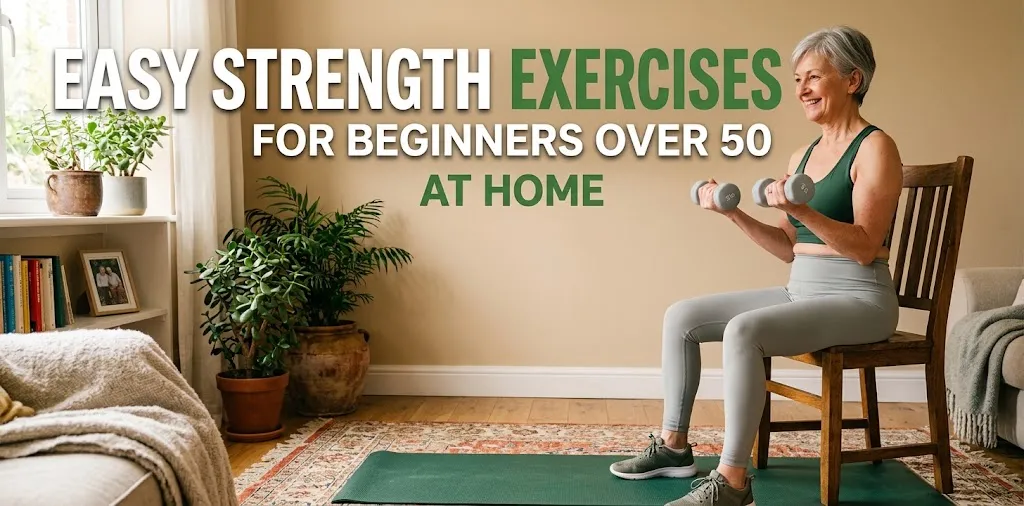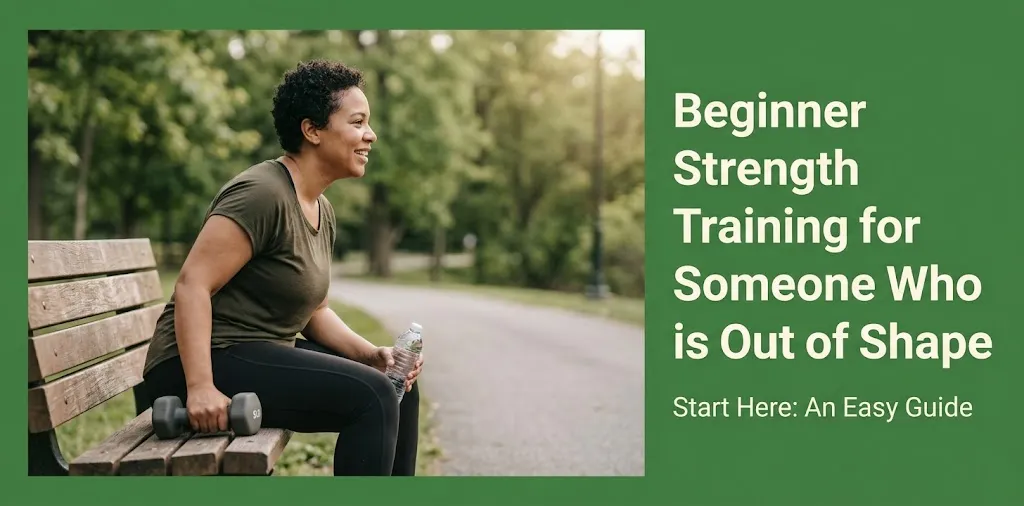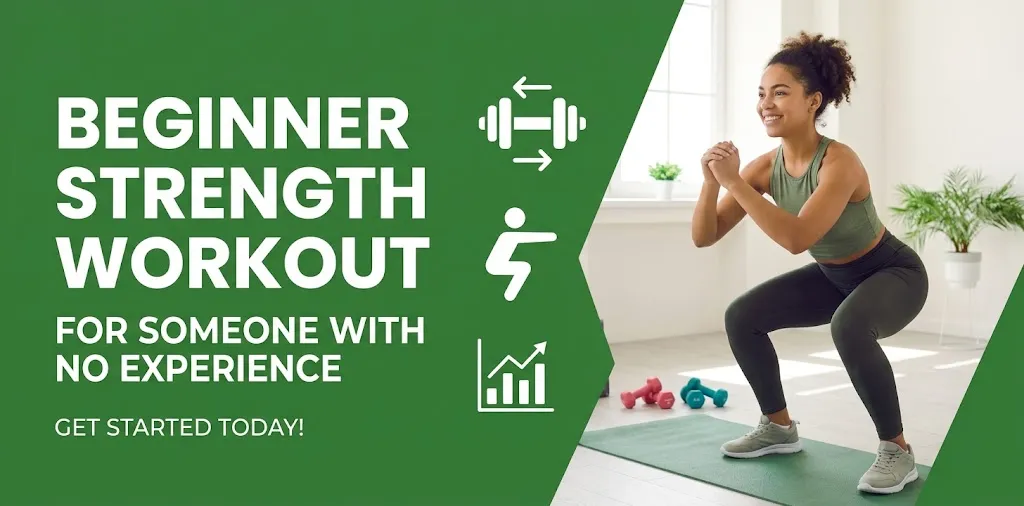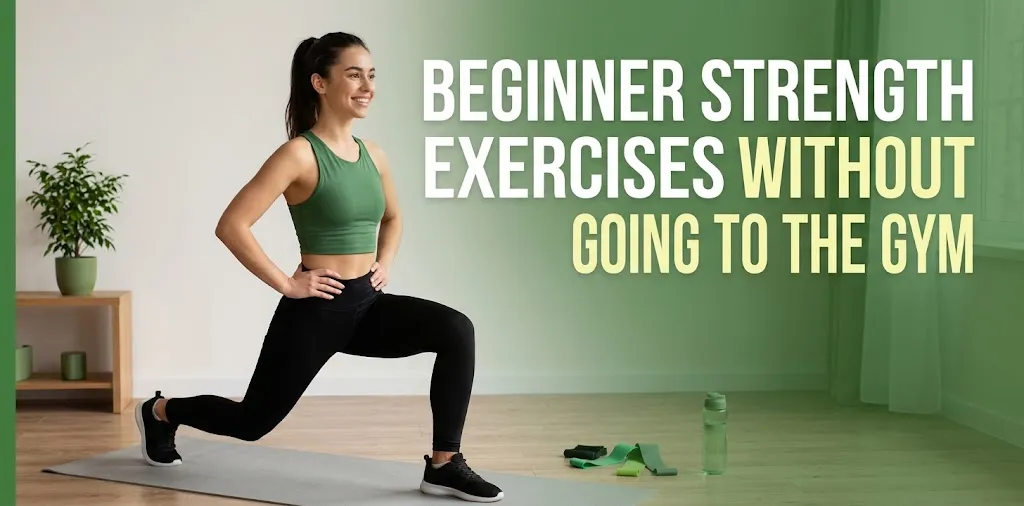
You do not need a gym, weight machines, or a full home gym to start building strength. For beginners, bodyweight exercises such as squats, wall push-ups, glute bridges, lunges, and planks can provide useful resistance. As you get stronger, you can make these movements harder with more repetitions, slower movement, harder variations, or simple equipment such as resistance bands.
The Best Beginner Strength Exercises at Home
The best starting routine should cover your major movement patterns rather than focusing on just one muscle. A simple full-body workout can train your legs, hips, chest, back, shoulders, arms, and core with little or no equipment.
| Exercise | Main muscles | Beginner version |
|---|---|---|
| Chair squat | Quads, glutes, hamstrings | Sit-to-stand |
| Wall push-up | Chest, shoulders, triceps | Wall push-up |
| Glute bridge | Glutes, hamstrings | Floor bridge |
| Reverse lunge | Legs, glutes | Supported lunge |
| Bird dog | Core, back, hips | Slow alternating reach |
| Plank | Core, shoulders | Wall or elevated plank |
| Calf raise | Calves | Supported calf raise |
| Backpack row | Upper back, arms | Light backpack row |
1. Chair Squats
Chair squats are one of the easiest ways to learn the basic squat pattern.
How to do them:
- Stand in front of a sturdy chair with your feet about shoulder-width apart.
- Push your hips back as if you are going to sit down.
- Bend your knees and lower yourself slowly.
- Lightly touch the chair.
- Press through your feet to stand.
Start with 8–12 repetitions.
Once the movement feels easy, stop using the chair or slow down the lowering portion of each repetition.
2. Wall Push-Ups
If a regular push-up is too difficult, start against a wall.
How to do them:
- Stand about an arm’s length from a wall.
- Place your hands on the wall around chest height.
- Keep your body in a straight line.
- Bend your elbows and bring your chest toward the wall.
- Push yourself back.
Try 8–12 repetitions.
As you improve, move from wall push-ups to push-ups against a sturdy countertop or table, then to knee or floor push-ups.
3. Glute Bridges
Glute bridges strengthen the muscles around your hips and the back of your legs.
How to do them:
- Lie on your back with your knees bent.
- Keep your feet flat on the floor.
- Place your arms beside you.
- Tighten your glutes and raise your hips.
- Pause briefly at the top.
- Lower your hips with control.
Start with 10–15 repetitions.
Avoid pushing your lower back into an exaggerated arch. Think about lifting your hips with your glutes.
4. Supported Reverse Lunges
Reverse lunges train one leg at a time and can help you develop lower-body strength and balance.
Hold a sturdy countertop or chair if you need support.
How to do them:
- Stand tall with your feet hip-width apart.
- Step one foot backward.
- Lower your body under control.
- Push through your front foot to return to standing.
- Repeat on the other side.
Start with 6–10 repetitions per leg.
If balancing feels difficult, keep one hand on a stable surface.
5. Bird Dogs
Bird dogs are a beginner-friendly core exercise that also challenges balance and coordination.
How to do them:
- Start on your hands and knees.
- Keep your back neutral.
- Slowly extend one arm and the opposite leg.
- Pause for a moment.
- Return to the starting position.
- Switch sides.
Perform 6–10 controlled repetitions per side.
Move slowly rather than trying to lift your arm and leg as high as possible.
6. Planks
Planks train your core while also requiring your shoulders and upper body to stabilize your position.
You do not need to begin with a floor plank.
Try a wall plank or place your hands on a sturdy countertop. As your core gets stronger, progress toward a lower surface and eventually a floor plank.
Start with 10–20 seconds and repeat for 2–3 sets.
Your goal is good alignment, not simply holding the position for as long as possible.
7. Calf Raises
Calf raises are simple but useful for building lower-leg strength.
How to do them:
- Stand behind a sturdy chair or near a countertop.
- Hold the surface for balance.
- Slowly raise your heels.
- Pause at the top.
- Lower your heels under control.
Begin with 10–15 repetitions.
When this becomes easy, perform the movement more slowly or progress to single-leg calf raises.
8. Backpack Rows
If you want to train your upper back without dumbbells, a backpack can provide adjustable resistance.
Put a few light items inside a sturdy backpack. Do not start with a heavy load.
How to do it:
- Hold the backpack securely.
- Hinge slightly forward at your hips while keeping your back neutral.
- Pull the backpack toward your lower ribs.
- Squeeze your shoulder blades gently.
- Lower the backpack slowly.
Start with 8–12 repetitions.
Make sure the backpack and straps are secure before using it as resistance.
A Simple No-Gym Strength Workout for Beginners
You do not need eight exercises every time you work out. A small group of movements can cover most of your body.
Try this routine 2 days per week, with at least a day between strength sessions when possible:
- Chair squats: 8–12 reps
- Wall push-ups: 8–12 reps
- Glute bridges: 10–15 reps
- Supported reverse lunges: 6–10 reps per leg
- Backpack rows: 8–12 reps
- Bird dogs: 6–10 reps per side
- Wall or elevated plank: 10–20 seconds
Start with one set of each exercise. If that feels manageable after several workouts, move toward two sets.
How to Make Bodyweight Exercises Harder
A common beginner mistake is thinking you need heavier weights as soon as an exercise becomes easy. You have several ways to increase the challenge.
Increase repetitions
If you can perform 8 repetitions comfortably, gradually work toward 10 or 12 while keeping good form.
Add another set
Moving from one set to two can increase the amount of work without changing the exercise.
Slow down
Try taking about three seconds to lower yourself during a squat or push-up. Slower movements can make a familiar exercise more challenging.
Use a harder variation
For example:
Wall push-up → countertop push-up → lower-surface push-up → floor push-up
Or:
Chair squat → bodyweight squat → split squat → supported single-leg variation
You do not have to rush through these stages. Stay at a level where you can control the movement.
Add simple resistance
Once bodyweight movements become comfortable, you can add resistance bands, dumbbells, or a carefully loaded backpack. You do not need complicated equipment to make steady progress.
How Often Should Beginners Do Strength Exercises?
For most healthy adults, 2 strength-training days per week is a practical starting point.
You could organize your week like this:
| Day | Activity |
|---|---|
| Monday | Full-body strength |
| Tuesday | Walking or normal daily activity |
| Wednesday | Rest or light movement |
| Thursday | Full-body strength |
| Friday | Walking or light activity |
| Saturday | Optional easy activity |
| Sunday | Rest or easy movement |
You do not have to follow this exact schedule. The best schedule is one that fits your life and that you can repeat consistently.
How Many Reps and Sets Should You Do?
Beginners do not need complicated programming.
A useful starting point is:
- 8–12 reps for many strength exercises
- 1 set when you are completely new
- Progress toward 2–3 sets as your fitness improves
- 10–20 seconds for beginner plank variations
- Stop or modify an exercise if your form breaks down
The final few repetitions should feel challenging, but you should still be able to maintain control.
What If You Cannot Do a Regular Push-Up or Squat?
That is normal for many beginners. The answer is not to skip strength training. Make the exercise easier.
For push-ups, start against a wall. For squats, use a sturdy chair. For lunges, hold a countertop. For planks, use a wall or elevated surface.
This approach lets you practice the movement while gradually building the strength needed for a harder version.
For example, someone who cannot perform a floor push-up could spend several weeks doing wall push-ups, then countertop push-ups, before testing a lower surface.
Do You Need Equipment to Build Strength at Home?
No. Bodyweight exercises can provide resistance without a gym or expensive equipment.
Optional equipment can make progression easier, though.
A simple home setup might include:
- Exercise mat
- Resistance bands
- One or two pairs of dumbbells
- Sturdy chair or countertop
- Backpack for light resistance
You do not need to buy everything at once. Start with exercises you can already perform safely and add equipment only when you have a reason to use it.
How to Warm Up Before Strength Training
A long warm-up is not necessary for a short beginner workout.
Spend several minutes moving easily before your first working set. You might walk around the room, perform gentle arm circles, practice a few easy chair squats, and move your hips and shoulders through comfortable ranges of motion.
Then perform an easier version of your first exercise before doing your normal sets.
The goal is to prepare your body for the movements rather than exhaust yourself before the workout begins.
Common Beginner Mistakes
Doing too much too soon
A hard first workout can leave you overly sore and make your next workout difficult.
Start with less than you think you can handle. You can always increase the workload later.
Chasing soreness
Muscle soreness is not a requirement for a productive workout. Focus on controlled movements and gradual improvement.
Using poor form to get more repetitions
Ten controlled repetitions are more useful for learning a movement than 20 rushed repetitions with poor control.
Training only the muscles you can see
Beginners sometimes focus heavily on push-ups and abdominal exercises while ignoring their legs and back.
A balanced routine should include pushing, pulling, squatting, hinging, single-leg work, and core stability.
Changing the workout every day
You do not need a different routine every time you exercise. Repeating basic movements gives you a chance to learn technique and measure progress.
Thinking short workouts do not count
A short session is still a session. Consistency matters more than trying to make every workout long or exhausting.
Two Beginner Examples
Example 1: Someone With Very Little Exercise Experience
Suppose you spend most of the day sitting and have not exercised regularly for several months.
Start with:
- Chair squats
- Wall push-ups
- Glute bridges
- Supported lunges
- Bird dogs
Perform one set of each exercise twice per week.
After a few weeks of consistent training, you might increase to two sets or move to harder exercise variations.
Example 2: Someone Who Already Walks but Wants More Strength
Suppose you walk several days a week but have never followed a strength routine.
You could keep your walking routine and add two short full-body strength sessions. Start with squats, push-ups, glute bridges, backpack rows, lunges, and planks.
This gives you a simple way to add strength training without replacing the activity you already enjoy.
When to Stop or Modify an Exercise
Exercise should challenge your muscles, but sharp or sudden pain is a reason to stop the movement.
You should also modify an exercise if you cannot control the movement, repeatedly lose your balance, or cannot maintain a safe position.
If you have a chronic health condition, disability, or other health concern that affects exercise, talk with a healthcare professional about the type and amount of activity that is appropriate for you.
If you have been inactive and plan to begin vigorous-intensity exercise, consider talking with a healthcare professional beforehand, especially if you have a health condition or other reason to be concerned about exercise safety.
How to Track Your Strength Progress
Do not rely only on the number on a scale.
Track simple changes such as:
- More repetitions with good form
- More sets completed comfortably
- A harder exercise variation
- Better balance
- Better control during each repetition
- A slightly heavier resistance band or dumbbell
- Less effort during an exercise that once felt difficult
For example, if you start with 8 wall push-ups and eventually perform 12 countertop push-ups with control, that is meaningful progress even if your body weight has not changed.
Frequently Asked Questions
Can beginners build strength without going to a gym?
Yes. Bodyweight exercises and simple home-based resistance exercises can build strength, especially when you are starting out. You can gradually increase repetitions, sets, resistance, or exercise difficulty as your strength improves.
How many days a week should a beginner do strength exercises at home?
Two days per week is a good starting target for most healthy adults. As you become more comfortable, you can adjust your routine based on your goals, recovery, and overall activity level.
What is the easiest strength exercise to start with?
Chair squats and wall push-ups are two accessible choices because you can easily adjust their difficulty. Start with a version you can perform with control, then gradually progress as it becomes easier.
Start With Simple Exercises and Build From There
You do not need a gym membership to begin strength training. Start with a few movements that train your whole body, perform them with controlled form, and give yourself time to improve.
For most beginners, two short full-body sessions each week are enough to establish a solid starting habit. Your practical next step is simple: clear a small area at home, choose five beginner-friendly exercises, and complete one easy set of each rather than waiting until you feel ready for a harder workout.