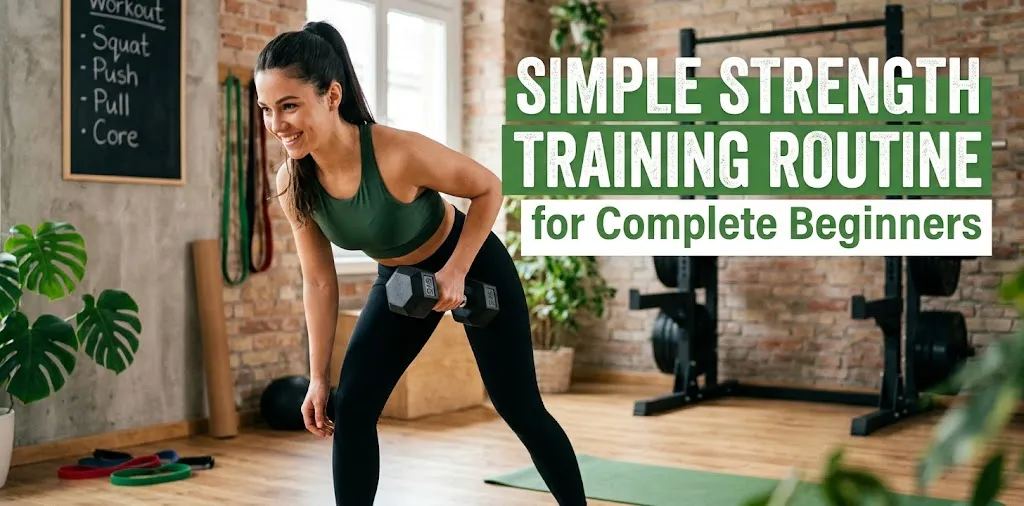
If you have never lifted weights before, the hardest part is often knowing where to start. You do not need a complicated gym program, heavy weights, or hours of training. A simple full-body routine done two or three times per week can help you learn basic movements, build strength, and create a routine you can maintain.
The key is to start light, focus on good form, train all major muscle groups, and gradually make the exercises more challenging.
A Simple Beginner Strength Routine
A complete beginner can start with a full-body workout two days per week, leaving at least one day between sessions. Each workout can take about 25–40 minutes.
For each exercise, start with 1–2 sets of 8–12 controlled repetitions. Rest about 60–120 seconds between sets. As you become comfortable with the movements, you can gradually add a set or slightly increase the resistance.
| Exercise | Sets | Reps | Beginner Option |
|---|---|---|---|
| Chair Squat | 1–2 | 8–12 | Sit back to a sturdy chair |
| Wall or Incline Push-Up | 1–2 | 8–12 | Use a wall for less resistance |
| Dumbbell or Band Row | 1–2 | 8–12 | Use a light resistance band |
| Glute Bridge | 1–2 | 10–15 | Bodyweight |
| Dumbbell Romanian Deadlift | 1–2 | 8–12 | Use very light dumbbells |
| Standing Shoulder Press | 1–2 | 8–12 | Use light dumbbells |
| Dead Bug | 1–2 | 6–10 per side | Move slowly |
The routine covers the major movement patterns without requiring a long list of exercises.
How to Schedule It
A simple weekly schedule might look like this:
- Monday: Full-body strength workout
- Tuesday: Rest or easy walking
- Wednesday: Rest or light activity
- Thursday: Full-body strength workout
- Friday: Rest
- Saturday: Optional easy walk or other enjoyable activity
- Sunday: Rest
You do not have to train on these exact days. The goal is to give your muscles recovery time while making strength training a regular part of your week.
If you are starting from a very inactive lifestyle, you can begin with one strength session during your first week and build toward two sessions.
What Each Exercise Does
Chair Squat
Stand in front of a sturdy chair with your feet about shoulder-width apart. Push your hips back, bend your knees, and lower yourself toward the chair. Lightly touch the chair, then stand up.
Chair squats train your quadriceps, glutes, and hips while giving beginners a clear depth target.
As the movement gets easier, move from a chair squat to a regular bodyweight squat and eventually add a dumbbell.
Wall or Incline Push-Up
Place your hands on a wall, countertop, or sturdy elevated surface. Keep your body straight as you bend your elbows and bring your chest toward the surface. Push yourself back.
This trains the chest, shoulders, and triceps.
A wall push-up is often easier than a floor push-up. When you can perform 10–12 controlled repetitions comfortably, use a lower surface to increase the challenge.
Dumbbell or Band Row
Hold light dumbbells or a resistance band. Keep your back in a comfortable neutral position and pull your hands toward your ribs. Slowly return to the starting position.
Rows strengthen the upper back, shoulders, and arms.
Avoid jerking the weight. The lowering portion should be controlled.
Glute Bridge
Lie on your back with your knees bent and feet flat on the floor. Tighten your abdominal muscles, press through your feet, and raise your hips. Pause briefly at the top before lowering.
The glute bridge works the glutes and muscles around the hips.
It is a useful starting exercise because you can perform it without equipment.
Dumbbell Romanian Deadlift
Stand with light dumbbells in front of your thighs. Keep your back neutral, soften your knees, and push your hips backward as the dumbbells move down your legs. Stop when you feel a comfortable stretch in the backs of your legs, then drive your hips forward to stand.
This teaches the hip-hinge movement and works the glutes and hamstrings.
If the movement feels unfamiliar, practice the hip hinge without weights first.
Standing Shoulder Press
Hold light dumbbells near shoulder height. Press them upward without leaning backward, then lower them slowly.
This exercise targets the shoulders and triceps.
Start with very light weights. You should be able to control the entire movement without using momentum.
Dead Bug
Lie on your back with your knees bent and arms raised. Slowly lower one arm and the opposite leg while keeping your trunk controlled. Return to the starting position and switch sides.
The dead bug helps beginners practice core control without needing heavy resistance.
If you cannot keep your lower back and torso controlled, shorten the movement.
How Much Weight Should a Beginner Use?
The right starting weight is one you can control for your planned repetitions while maintaining good technique.
You should not need to test your maximum strength when you are just starting.
A simple approach is:
- Choose a very light weight.
- Perform several controlled repetitions.
- Check your technique.
- Stop before your form starts breaking down.
- Increase the resistance gradually as the exercise becomes easier.
You do not need to train until complete muscle failure. The goal is to make the muscles work hard while maintaining control.
How to Progress Without Making the Routine Complicated
Progressive overload simply means gradually asking your muscles to do a little more work over time.
You can progress by:
- Adding a few repetitions
- Adding a small amount of weight
- Moving to a harder exercise variation
- Adding another set
- Improving your control and range of motion
You do not need to increase everything at once.
For example, suppose you begin with chair squats using your body weight and can comfortably perform 8 repetitions. Over the next few workouts, you might work toward 12 repetitions. Once 12 feels easy and your form remains solid, you could move to regular squats or add a light dumbbell.
The goal is steady progress, not exhausting yourself every workout.
Your First Four Weeks
You can keep the same basic routine for your first month instead of changing exercises every few days.
| Week | Frequency | Main Goal |
|---|---|---|
| Week 1 | 2 days | Learn the movements |
| Week 2 | 2 days | Improve control and consistency |
| Week 3 | 2 days | Add a few reps or small resistance |
| Week 4 | 2–3 days | Continue progressing if recovery is good |
During the first week, it is perfectly reasonable to do only one set of each exercise. Your goal is to finish the workout feeling like you could have done more.
By the second or third week, you may be ready for two sets of most exercises.
How to Warm Up Before Strength Training
You do not need a long or complicated warm-up.
Spend about 5 minutes preparing your body with easy movements such as:
- Walking around the room
- Arm circles
- Bodyweight squats to a chair
- Gentle hip hinges
- Shoulder movements
- Easy repetitions of your first exercise
Then perform a few lighter repetitions before your working sets if you are using weights.
The warm-up should prepare you for the workout, not tire you out before it begins.
Home vs. Gym: Which Is Better for a Beginner?
Both can work.
You can begin at home with bodyweight exercises and inexpensive resistance bands. You can also use a pair of light dumbbells or adjustable dumbbells as you progress.
A gym gives you access to more equipment and makes it easier to increase resistance in small steps. But you do not need a gym membership to begin strength training.
| If you prefer… | Start with… |
|---|---|
| Privacy and convenience | Home workouts |
| Minimal equipment | Bodyweight exercises |
| Low-cost training | Bodyweight or resistance bands |
| More exercise choices | Gym |
| Easy weight progression | Dumbbells or gym equipment |
The best option is the one you can use consistently.
How Long Should a Beginner Workout Last?
Your strength workout does not need to last an hour.
For this routine, 25–40 minutes is enough for most beginners when you include a short warm-up and rest periods.
If you only have 15–20 minutes, you can still do a shorter workout. For example, perform:
- Chair squats
- Incline push-ups
- Rows
- Glute bridges
Then gradually add exercises as you have more time.
Common Beginner Mistakes
Starting Too Heavy
Using more weight than you can control makes it harder to learn proper movement. Start lighter than you think you need and increase resistance when your technique is consistent.
Doing Too Many Exercises
A beginner does not need 15 different exercises in one workout. A small number of movements covering the major muscle groups is enough to build a strong foundation.
Training Hard Every Day
More training is not automatically better. Strength workouts create a reason for your body to adapt, while recovery gives you time to recover from the training.
Two well-planned full-body sessions each week can be a better starting point than trying to lift weights every day.
Changing the Routine Constantly
If you change exercises every workout, it becomes harder to tell whether you are improving. Keep your main movements consistent long enough to learn them and measure progress.
Ignoring Pain
Muscle fatigue and effort are normal. Sharp, sudden, or worsening pain is different.
Stop an exercise that causes concerning pain rather than trying to push through it. If you have an injury, chronic condition, or other health concern that may affect exercise, talk with a qualified health professional about an appropriate program.
How to Make Strength Training a Habit
The simplest routine is useless if you cannot stick with it.
Try these practical strategies:
- Choose two specific workout days each week.
- Keep your first workouts short.
- Put your workout clothes out ahead of time.
- Keep dumbbells or resistance bands somewhere easy to reach.
- Record your exercises, reps, and weights.
- Repeat the same basic routine while you are learning.
- Increase difficulty slowly.
- Take rest days when needed.
Consistency matters more than having a perfect program.
For example, someone who completes two 30-minute workouts every week is building a more useful habit than someone who performs one exhausting workout and then stops for three weeks.
How Strength Training Fits With Cardio
Strength training and cardio serve different purposes, and you can combine them in the same weekly plan.
A beginner might combine the two like this:
- Monday: Strength training
- Tuesday: 20–30 minute easy walk
- Wednesday: Rest
- Thursday: Strength training
- Friday: 20–30 minute easy walk
- Saturday: Optional recreational activity
- Sunday: Rest
Walking, cycling, swimming, dancing, and other activities can provide aerobic exercise. Choose activities you enjoy and can perform comfortably.
When Should You Increase the Difficulty?
Increase the difficulty when the current exercise feels clearly manageable and your technique remains consistent.
For example, if you can complete 12 chair squats with good control and still have plenty of energy left, you may be ready to try regular squats or add a small amount of resistance.
Do not increase weight just because a calendar says it is time.
A better progression is:
Good form → comfortable repetitions → slightly more resistance or difficulty → repeat.
This keeps the focus on gradual improvement.
What If You Are Completely Out of Shape?
You can make the routine easier.
Start with:
- One set instead of two
- Fewer repetitions if needed
- Wall push-ups instead of floor push-ups
- Chair squats instead of unsupported squats
- Bodyweight exercises instead of weights
- Longer rest periods
- One or two workouts per week
If you have been inactive for a long time, there is no need to prove how fit you are on the first day.
Start with a manageable amount of activity and build up gradually.
Two Realistic Beginner Examples
Example 1: The Busy Office Worker
A hypothetical beginner who works at a desk from 9 a.m. to 5 p.m. might train at home on Tuesday and Saturday evenings.
Each session could include chair squats, incline push-ups, resistance-band rows, glute bridges, and a core exercise. Starting with one set of each movement keeps the workout manageable.
After a few weeks, the person could move to two sets and gradually add resistance.
Example 2: Someone Returning After Years Away
Another hypothetical beginner may already walk occasionally but has not done resistance training for several years.
Instead of immediately joining a demanding gym program, they could begin with two short full-body sessions each week using bodyweight movements and light dumbbells.
The first goal is not maximum strength. It is learning the movements, recovering well, and making the routine regular.
When to Get Medical Guidance Before Starting
Strength training is appropriate for many adults, but individual circumstances matter.
Talk with a health professional before starting or significantly increasing exercise if you have a chronic health condition, disability, significant injury, or another concern that may affect what activities are appropriate for you.
If you are currently inactive and considering vigorous exercise, getting professional guidance first may also be appropriate in certain circumstances.
Frequently Asked Questions
How many days a week should a complete beginner do strength training?
Two full-body strength sessions per week are a practical starting point for many beginners. You can add another session later if you are recovering well and want more training.
Should beginners use weights or bodyweight exercises?
Either option can work. Bodyweight exercises, resistance bands, and free weights can all provide resistance, so choose the option that lets you perform the movement safely and progress gradually.
How long does it take to get stronger from beginner strength training?
Strength can improve as you consistently practice resistance exercises, but the timeline varies from person to person. Focus first on completing your workouts regularly, learning good technique, and gradually increasing the challenge rather than expecting a specific result by a certain date.
Start With Less Than You Think You Need
A simple strength training routine for complete beginners does not need to be complicated. Start with two full-body workouts per week, use manageable resistance, learn a handful of basic movements, and increase the challenge slowly.
Your first goal should be consistency, not exhaustion. Once two weekly workouts become normal, you can gradually add resistance, repetitions, or more challenging variations. That simple approach gives you a practical foundation for becoming stronger without making your first month of exercise overwhelming.