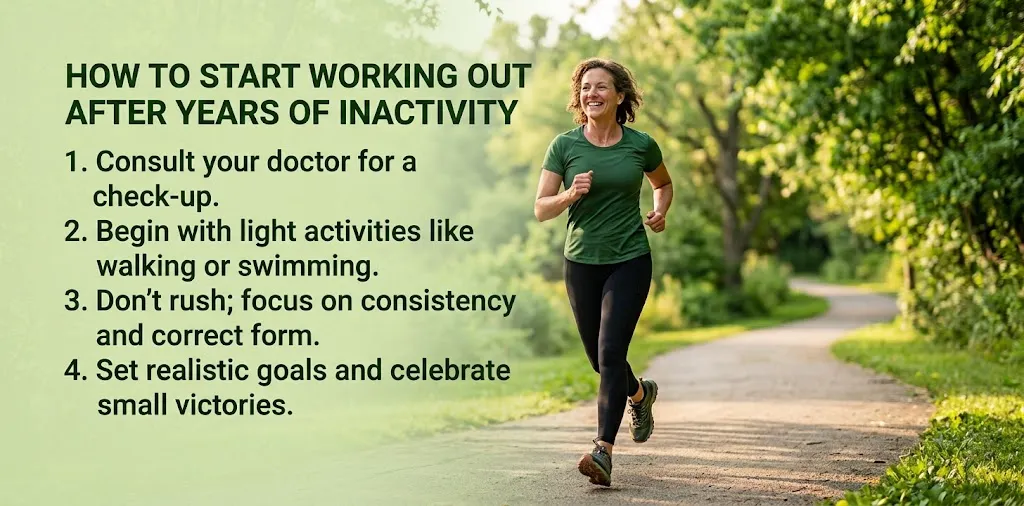
Getting back to exercise after years away can feel harder than expected. You may get tired quickly, feel stiff, or worry that you are too far out of shape to begin. The good news is that you do not need to become fit before you start. You need to start at a level your current body can handle and build from there.
Start With Your Current Fitness Level
If you have been inactive for years, do not use your old fitness level as your starting point. The fact that you once ran, lifted weights, played sports, or exercised regularly does not mean your body is ready to do the same workouts today.
The first goal is simple: get your body used to moving again.
For the first couple of weeks, focus on activities that feel manageable rather than trying to get the hardest workout possible. Walking, easy cycling, gentle mobility work, water exercise, and simple strength exercises can all be useful starting points.
Federal guidelines recommend that adults eventually work toward at least 150 minutes of moderate-intensity aerobic activity each week plus muscle-strengthening activity on at least two days. But you do not have to reach that amount immediately. Some activity is better than none, and the amount can be increased gradually.
Check Whether You Should Talk With a Health Professional First
Many healthy adults can begin with light activity and gradually increase it. However, if you have a chronic health condition, a disability, significant physical limitations, or concerns about whether exercise is appropriate for you, talk with a health professional about the type and amount of activity that fits your situation.
If exercise causes unusual or severe symptoms, stop and seek appropriate medical advice rather than trying to push through them.
Make Walking Your First Workout
Walking is one of the simplest ways to restart an exercise habit because you can control the pace, distance, and duration.
You do not need to begin with a long walk. If 10 minutes feels like enough, start there.
A simple progression might look like this:
| Stage | Example session | Main goal |
|---|---|---|
| Week 1 | 10–15 minute easy walks, 3 days | Get used to regular movement |
| Week 2 | 15–20 minute walks, 3–4 days | Increase time gradually |
| Week 3 | 20–25 minute walks, 4 days | Build basic endurance |
| Week 4 | 25–30 minute walks, 4–5 days | Establish a regular routine |
This is an example, not a required schedule. If one stage feels difficult, stay there longer.
How Hard Should Your Walk Feel?
For moderate activity, you should be breathing harder but still able to have a conversation. You should not feel like you are racing to finish the workout.
A useful progression is:
Easy → comfortable → moderately challenging → harder
Do not skip several steps just because you feel motivated on one particular day.
Add Simple Strength Training
Cardio is only part of getting back into shape. Strength training helps you rebuild your ability to perform everyday movements and supports the muscle-strengthening portion of the federal activity guidelines.
You do not need a gym or heavy weights at first.
A beginner session could include:
- Chair squats: Sit toward a sturdy chair and stand back up.
- Wall push-ups: Place your hands on a wall and perform controlled push-ups.
- Standing calf raises: Hold a stable surface and slowly raise your heels.
- Glute bridges: Lie on your back and gently raise your hips if this movement is comfortable.
- Standing hip hinges: Practice bending at your hips while keeping your back comfortable.
Start with a small number of controlled repetitions rather than trying to exhaust the muscles.
A Simple Beginner Strength Session
Try two sessions per week with rest days between them.
For each exercise, begin with a comfortable number of repetitions and stop before your form breaks down. Rest as needed.
The goal during the first few weeks is not to see how much weight you can lift. It is to relearn movement and create a habit you can maintain.
Follow a Gradual 4-Week Return-to-Exercise Plan
A structured plan can make the first month less confusing.
Week 1: Just Start Moving
Aim for about three activity days.
For example:
- Monday: 10–15 minute easy walk
- Wednesday: 10–15 minute easy walk
- Saturday: 10–15 minute easy walk
On other days, look for small ways to move more, such as taking short walking breaks.
You should finish these sessions feeling like you could have done a little more.
Week 2: Add a Little More Time
Move for roughly 15–20 minutes on three or four days.
You can also add one short strength session using simple bodyweight movements.
Do not increase both the duration and intensity dramatically at the same time.
Week 3: Build Your Routine
Work toward four activity days if your body is handling the previous weeks well.
You might have:
- Two walking sessions
- One longer easy walk
- Two short strength sessions
Some sessions can be short. The point is to make exercise a normal part of your week.
Week 4: Increase Gradually
If you feel comfortable, extend some walks toward 25–30 minutes and continue strength training twice during the week.
From here, you can slowly increase the amount of moderate activity until you are working toward 150 minutes per week. Remember that the guideline is a longer-term target, not a test you need to pass during your first week.
Do Not Try to Make Up for Lost Time
One of the biggest mistakes after years of inactivity is trying to exercise like your old self.
You may remember being able to run five miles, lift heavy weights, or complete an intense fitness class. That memory can create unrealistic expectations.
For example, imagine someone who used to run regularly but has spent the last six years mostly sitting at work. Going straight into a five-mile run because they used to do it could turn a positive decision into an unnecessarily difficult workout.
A better approach is to rebuild the foundation first.
Think of your old fitness as a reference point, not a deadline.
Learn the Difference Between Challenge and Overdoing It
Exercise should feel like work, especially as your fitness improves. But there is a difference between being challenged and pushing beyond what your body can currently handle.
Signs You May Be Doing Too Much
Watch for problems such as:
- Pain that changes how you move
- Excessive fatigue that does not improve with rest
- Persistent soreness that interferes with normal activities
- Repeated dizziness or feeling faint
- A sharp or unusual pain during exercise
- Symptoms that feel significantly different from normal exertion
Do not assume that more pain means a better workout.
If you develop concerning symptoms, stop the activity and get appropriate medical advice.
Warm Up and Cool Down
You do not need a complicated warm-up routine.
Before walking or strength training, spend several minutes moving gently. You could walk slowly, move your arms, or perform other comfortable movements related to your workout.
Afterward, gradually reduce your activity instead of stopping suddenly.
A slow five- to 10-minute period before and after exercise can help you transition into and out of your workout.
Choose Exercise You Can Actually Repeat
The most effective workout for someone returning after years of inactivity is often the one they are willing to do again.
You might prefer:
- Walking outdoors
- Treadmill walking
- Swimming
- Stationary cycling
- Beginner yoga
- Low-impact fitness classes
- Resistance bands
- Basic bodyweight exercises
- Light weight training
You do not have to choose the exercise that looks most impressive.
If you hate running, you do not need to run.
If you enjoy walking while listening to music or a podcast, use that preference to make movement easier to repeat.
Make Exercise Easier to Fit Into Your Day
A common problem is treating exercise as something that requires a completely free hour.
It does not.
You can divide activity into smaller periods. For example, instead of looking for one uninterrupted 30-minute block, you might take:
- A 10-minute walk before work
- A 10-minute walk during lunch
- A 10-minute walk after dinner
Three short walks can be much easier to fit into a busy schedule.
Use a Simple Habit Cue
Connect exercise to something you already do.
For example:
After breakfast → put on walking shoes → walk for 10 minutes.
Or:
After work → change clothes → complete a short strength session.
Leaving your shoes, resistance bands, or workout clothes somewhere visible can also serve as a reminder.
What to Do When You Feel Extremely Out of Shape
You may notice that ordinary activities make you tired at first. That does not automatically mean you cannot exercise.
Instead, reduce the starting point.
If 20 minutes of walking is too much, try 5–10 minutes.
If regular squats are difficult, use a chair for support.
If a full workout feels overwhelming, complete one or two exercises and stop.
Your starting point is allowed to be small.
What to Do About Soreness After Your First Workouts
Some muscle soreness can happen when you introduce your body to activities it has not done regularly. That does not mean you should train the same muscles harder the next day.
Give your body time to recover.
During recovery days, you can do light movement if it feels comfortable. You can also use those days to focus on normal daily activity rather than another demanding workout.
If pain is severe, unusual, persistent, or affecting normal movement, do not assume it is ordinary workout soreness.
When Should You Increase Your Workout?
Increase your activity when your current routine feels manageable rather than because a calendar tells you that you must.
You can gradually change one factor at a time:
- Increase workout duration.
- Add another easy activity day.
- Increase walking pace.
- Add resistance.
- Add another set of an exercise.
There is no need to increase everything at once.
A gradual approach gives you more room to notice how your body responds.
How to Stay Consistent After the First Month
Starting is often easier than continuing.
After the excitement of the first few weeks fades, your routine needs to fit normal life.
Try these strategies:
- Schedule workouts like other appointments.
- Keep your first sessions short enough to feel manageable.
- Exercise at a convenient location.
- Track completed workouts rather than only measuring physical results.
- Have a backup workout for busy days.
- Expect occasional missed sessions.
- Restart at the next opportunity instead of waiting for Monday.
Missing one workout does not erase your progress.
The goal is not to create a perfect month. It is to create a routine that can survive busy weeks, travel, bad weather, low motivation, and other normal interruptions.
A Practical Weekly Routine for Someone Starting Again
Once you can comfortably handle basic activity, a simple week could look like this:
| Day | Activity |
|---|---|
| Monday | 20–30 minute walk |
| Tuesday | Short strength session |
| Wednesday | Easy walk or light movement |
| Thursday | Rest or easy movement |
| Friday | 20–30 minute walk |
| Saturday | Short strength session |
| Sunday | Rest or comfortable walk |
Adjust the schedule to your current ability and lifestyle. You can use shorter sessions if needed.
Over time, gradually work toward the recommended weekly amount of aerobic activity and two days of muscle strengthening.
Frequently Asked Questions
Is it too late to start exercising after years of inactivity?
No. You can begin at your current fitness level and build gradually. Even small amounts of physical activity can be useful, and regular activity can become part of your routine over time.
How long should a beginner workout after years of inactivity?
There is no single starting duration that works for everyone. If you have been inactive for years, starting with a short, comfortable session such as 10–15 minutes can be reasonable, then gradually increasing the duration as your body adapts.
Should I walk or lift weights first?
Walking is a simple way to rebuild basic activity and endurance, while strength training helps rebuild muscular fitness. You do not necessarily have to choose one; once your body is ready, gradually including both can help you build overall fitness.
The Best First Step Is Smaller Than You Think
Starting to work out after years of inactivity is not about proving how fit you can become in one week. It is about giving your body a manageable amount of movement and then slowly asking it to do a little more.
Start with an activity you can repeat. Keep the first sessions easy enough that you are willing to come back. As your fitness improves, gradually add time, strength, and intensity.
Your next workout does not need to be impressive. It just needs to be a safe, manageable step forward.