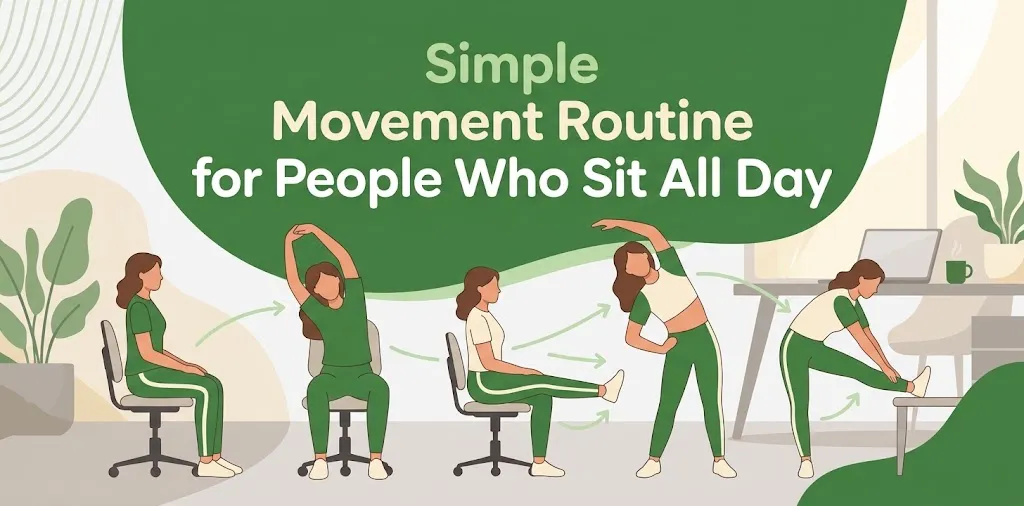
Sitting for hours can leave your hips, back, shoulders, and neck feeling stiff. The good news is that you do not need a long workout to start moving more. A few minutes of gentle movement throughout the day can help break up long periods of sitting and make activity easier to fit into a busy workday.
A Simple Movement Routine for People Who Sit All Day
A simple routine should combine short movement breaks with easy exercises that move the neck, shoulders, spine, hips, and legs. Try standing up regularly, walking for a few minutes, and doing gentle movements such as shoulder rolls, hip circles, chair squats, and calf raises. The goal is not to replace regular exercise but to spend less of the day completely still.
Federal physical activity guidance recommends that adults move more and sit less. Adults should gradually work toward at least 150 minutes of moderate-intensity aerobic activity each week plus muscle-strengthening activity on at least 2 days.
Why Short Movement Breaks Matter
When your workday keeps you in the same chair for hours, it is easy to go from one long sitting period to another without realizing it. Breaking up that pattern gives you more chances to move without needing to schedule another full workout.
Short movement breaks can be practical during a busy workday. Standing up, walking to refill your water bottle, climbing a few stairs, or doing several controlled movements can all help interrupt long periods of sitting.
The key is to avoid thinking that every break has to be a workout.
Your 5-Minute Desk Break Routine
You can do this routine at work, at home, or anywhere you have enough space to stand safely. You do not need gym equipment.
| Movement | Amount | Main focus |
|---|---|---|
| Easy walk or march | 60 seconds | Whole body |
| Shoulder rolls | 10 forward + 10 backward | Shoulders |
| Standing side reach | 5 each side | Torso |
| Chair squats | 8–12 reps | Legs and hips |
| Calf raises | 10–15 reps | Lower legs |
| Hip circles | 5 each direction | Hips |
| Easy walk | 30–60 seconds | Whole body |
Move slowly and stay within a comfortable range. You should not need to force a stretch or push through pain.
1. Walk or March in Place
Start with about one minute of easy movement.
If you can leave your desk, walk around the office, hallway, or home. If you cannot, march gently in place while keeping your posture comfortable.
The purpose is simple: stop sitting and get your body moving.
2. Shoulder Rolls
Stand or sit tall.
Roll your shoulders slowly upward, backward, and down. Repeat in one direction and then reverse it.
This is especially convenient after spending a long time typing or using a mouse.
3. Standing Side Reaches
Stand with your feet about hip-width apart.
Raise one arm and gently reach toward the opposite side without forcing your torso. Return to the center and switch sides.
Keep the movement controlled rather than trying to reach as far as possible.
4. Chair Squats
Stand in front of a sturdy chair with your feet about hip- to shoulder-width apart.
Lower your hips toward the chair as if you are going to sit, then stand back up. Keep the movement slow and controlled.
If this is difficult, use your hands on the desk or chair for support. If it feels easy, you can gradually increase the number of repetitions.
5. Calf Raises
Hold a sturdy desk, counter, or chair if needed.
Rise onto the balls of your feet, pause briefly, and lower your heels slowly.
This is an easy way to add some lower-body movement during a short break.
6. Hip Circles
Stand with your feet comfortably apart.
Place your hands on your hips and make small, controlled circles. Change direction after several repetitions.
Keep the circles comfortable. Larger is not automatically better.
7. Finish With an Easy Walk
Take another 30 to 60 seconds to walk around.
If you have more time, continue for several minutes. A short walk can turn a quick stretch break into a useful activity break.
A 10-Minute Routine for Longer Breaks
If you have a little more time, use this version instead of the 5-minute routine.
- 2 minutes: Easy walking or marching
- 1 minute: Shoulder rolls and arm circles
- 1 minute: Gentle side reaches
- 2 minutes: Chair squats and calf raises
- 1 minute: Standing hip circles
- 1 minute: Gentle torso rotations
- 2 minutes: Easy walking
You can do the entire routine without changing into workout clothes.
The best routine is one that fits naturally into your day. If 10 minutes feels difficult to schedule, use the 5-minute version instead.
How Often Should You Take Movement Breaks?
There is no single number of minutes that every adult must stand or move after sitting. Current U.S. physical activity guidance emphasizes moving more and sitting less rather than setting one required daily sitting limit or break schedule.
For practical purposes, you can use a simple habit:
- Short break: Move for 1–3 minutes.
- Regular break: Walk or move for about 5 minutes.
- Longer break: Take 10 minutes when your schedule allows.
- After several hours of work: Add a longer walk instead of relying only on desk stretches.
You do not need to set a strict timer. Your work schedule, mobility, fitness level, and personal preferences all matter.
A Simple Workday Schedule
The easiest way to make movement a habit is to attach it to things you already do.
| Part of the day | Movement idea |
|---|---|
| Before work | 5-minute walk |
| After starting work | Stand and move for 1–2 minutes |
| Mid-morning | Walk to get water |
| Before lunch | 5-minute movement routine |
| After lunch | Short walk |
| Mid-afternoon | Chair squats, calf raises, and shoulder rolls |
| End of work | 5–10 minute walk |
You can also connect movement with everyday tasks.
For example, stand while taking a phone call, walk to speak with a coworker instead of sending a message when practical, or take the longer route to the restroom.
These small choices can add movement without making your day feel like a fitness program.
What to Do If You Cannot Leave Your Desk
Some jobs make it hard to walk away from your workstation. You can still change position and move your body.
Try:
- Shoulder rolls
- Gentle neck movements
- Wrist and finger movements
- Seated torso rotations
- Ankle circles
- Heel raises
- Standing for part of a phone call
- Marching in place during a suitable break
Seated movements can be useful when standing is not practical, but they should complement walking and other forms of physical activity when you are able to do them.
Two Realistic Examples
Example 1: Remote Worker
Imagine you work from home and spend most of an 8-hour workday at a laptop.
Instead of waiting until the evening to move, you could take a 2-minute movement break after each major work task. At lunch, take a 10-minute walk. In the afternoon, do the 5-minute routine before returning to your computer.
You are not trying to turn every break into exercise. You are simply reducing the amount of uninterrupted sitting.
Example 2: Office Worker
Suppose you work in an office where leaving your desk often is difficult.
You could stand during phone calls, walk to refill your water bottle, use the stairs when practical, and perform shoulder rolls and calf raises during short breaks.
At lunch, a short walk can provide a longer period of movement before you return to your desk.
How to Progress Without Making the Routine Harder
If you have been inactive for a while, do not feel that you need to start with a demanding workout.
Start with the easiest version:
Week 1: Take several short movement breaks during the workday.
Week 2: Add a 5-minute walk during lunch or another reliable part of the day.
Week 3: Add chair squats, calf raises, or another simple strength exercise a few times per week.
Week 4: Gradually increase your walking time or add another short activity session.
The long-term goal can be to work toward at least 150 minutes of moderate-intensity activity per week and muscle-strengthening activity on at least 2 days. You do not have to reach that amount immediately. Some activity is better than none, and building activity gradually can make the habit easier to maintain.
Common Mistakes to Avoid
Waiting Until the End of the Day to Exercise
A workout after work can be valuable, but it does not mean you need to remain seated all day before doing it.
Use both approaches: regular movement during the day and planned exercise when you have time.
Making Every Break Too Intense
You do not need hard workouts every time you stand up.
A short walk or gentle mobility routine may be much easier to repeat.
Stretching Through Pain
Movement should generally feel controlled and manageable. Sharp pain, new numbness, tingling, dizziness, or other concerning symptoms are reasons to stop rather than push harder.
Trying to Fix Everything With a Standing Desk
A standing desk can change your position, but standing still for long periods is not the same as being physically active.
Think in terms of changing positions, walking, and moving, rather than simply replacing every hour of sitting with an hour of standing.
Making the Routine Too Complicated
If you need a mat, resistance bands, special clothing, and 30 free minutes before you can start, the routine may be difficult to maintain.
A chair, a little floor space, and a few minutes are enough to begin.
When to Modify the Routine
If you have a chronic health condition, disability, injury, significant joint problems, or another health concern that affects movement, the right exercises and intensity may be different for you.
If you have been inactive and want to begin vigorous exercise, consider talking with a doctor first if you have health concerns or other individual risk factors.
Frequently Asked Questions
Is a 5-minute movement routine enough if I sit all day?
A 5-minute routine is a useful starting point, but it should not be viewed as a complete replacement for regular physical activity. Use short movement breaks to interrupt sitting, then gradually build toward the recommended weekly amount of aerobic and muscle-strengthening activity.
What is the best exercise for someone who sits all day?
There is no single best exercise. Walking, chair squats, calf raises, gentle mobility exercises, and simple strength training can all be useful. The best choices are movements you can perform safely and repeat consistently.
Should I stretch every time I get up from my desk?
No. You do not need to stretch during every break. Some breaks can simply involve walking, standing, changing position, or doing a few easy strength movements. Variety helps you avoid turning every movement break into the same routine.
Make Movement Part of the Workday
You do not need to wait for a perfect workout window to become more active. Start by breaking up long periods of sitting with short walks, gentle mobility, and simple strength movements.
A practical first step is to set one reminder during your workday and use it to complete the 5-minute routine above. Once that feels normal, add another movement break or a short daily walk. Small habits are easier to maintain when they fit into the life you already have.