Starting exercise for the first time can feel harder than the workout itself. You may not know which exercises to do, how long to work out, or whether you are fit enough to begin. The good news is that you do not need a gym, expensive equipment, or a tough workout to get started.
For someone who has never exercised, the best approach is simple: start small, learn basic movements, recover between sessions, and slowly build up. This beginner-friendly home workout gives you a practical place to start without making your first week unnecessarily difficult.
What Is the Best Home Workout for Someone Who Has Never Exercised?
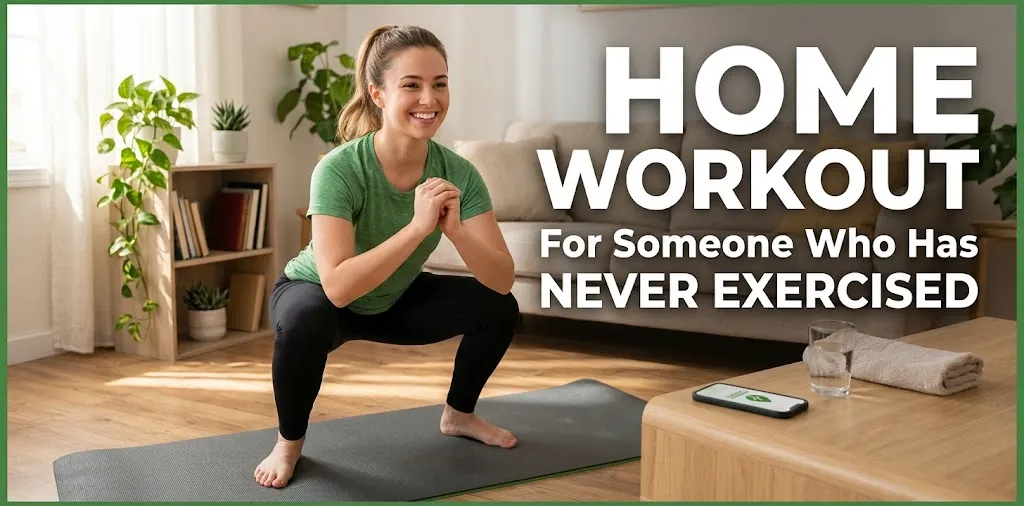
A good first home workout should use simple full-body movements and take about 15–20 minutes. Start with exercises such as marching in place, chair squats, wall push-ups, glute bridges, and gentle core work. Do each movement slowly and stop before your form breaks down. The goal at first is to build comfort and consistency, not to finish an exhausting workout.
Before You Start
If you have been completely inactive, do not feel pressured to exercise like someone who has trained for years. Your muscles, joints, balance, and cardiovascular system need time to adapt.
For your first few sessions:
- Wear comfortable shoes and clothing.
- Clear enough floor space to move safely.
- Keep water nearby.
- Use a sturdy chair or wall when needed.
- Keep the workout short.
- Focus on controlled movement instead of speed.
- Leave at least a day between harder beginner workouts.
If you have a medical condition, significant joint problems, chest pain, unexplained dizziness, or other health concerns, talk with a health professional about an appropriate starting point before exercising.
Your First 20-Minute Home Workout
This routine is designed for a true beginner. You can do it in a living room, bedroom, basement, or another safe area of your home.
Start with a 5-minute warm-up, complete the five exercises below, and finish with a few minutes of easy movement.
| Exercise | Starting Amount | Main Focus |
|---|---|---|
| March in place | 1–2 minutes | Cardio and coordination |
| Chair squat | 8–10 reps | Legs and hips |
| Wall push-up | 6–10 reps | Chest, shoulders, and arms |
| Glute bridge | 8–12 reps | Glutes and hips |
| Standing knee raise | 6–10 each side | Core and balance |
You do not need to complete several rounds on your first day. One round is enough if you are truly starting from zero.
1. March in Place
Stand tall and slowly march in place. Lift one foot at a time while gently moving your arms.
Keep the movement comfortable. You should not feel like you are racing.
Start with: 1–2 minutes.
If lifting your knees feels difficult, make the movement smaller. You can also hold the back of a sturdy chair for balance.
2. Chair Squat
Place a sturdy chair behind you. Stand with your feet about hip-width apart.
Push your hips backward and slowly lower yourself toward the chair. Lightly touch the seat, then stand back up.
Keep your chest comfortably lifted and move at a controlled pace.
Start with: 8–10 repetitions.
If this feels difficult, use your hands on the chair or reduce how far you lower yourself.
3. Wall Push-Up
Stand facing a wall and place your hands on it around chest height. Step your feet back slightly.
Bend your elbows and bring your chest toward the wall. Then push yourself away.
Keep your body in a straight line rather than letting your hips drop.
Start with: 6–10 repetitions.
As you become stronger, you can move from wall push-ups to push-ups against a sturdy countertop, then eventually to an elevated surface or the floor.
4. Glute Bridge
Lie on your back with your knees bent and your feet flat on the floor.
Press through your feet and gently lift your hips. Pause briefly at the top, then lower yourself slowly.
Do not worry about lifting your hips as high as possible. A comfortable range of motion is enough.
Start with: 8–12 repetitions.
This exercise helps you practice using your hips and glutes without needing weights.
5. Standing Knee Raise
Stand near a wall or sturdy chair if you need support.
Slowly lift one knee toward your waist, lower it, and then switch sides. Keep your torso controlled instead of leaning backward.
Start with: 6–10 repetitions per side.
If balance is challenging, hold the chair with one hand.
How to Warm Up Before Your Workout
A beginner does not need a complicated warm-up. Five minutes of easy movement is enough to prepare you for the session.
Try:
- March slowly in place for one minute.
- Move your shoulders forward and backward.
- Make gentle arm circles.
- Slowly bend and straighten your knees.
- Take several easy steps around the room.
The purpose is to gradually increase movement and prepare your body, not to tire yourself out before the workout begins.
How Many Days a Week Should a Complete Beginner Exercise?
Start with 2–3 workout days per week, leaving recovery time between sessions.
For example:
| Day | Activity |
|---|---|
| Monday | Beginner home workout |
| Tuesday | Easy walking or rest |
| Wednesday | Rest |
| Thursday | Beginner home workout |
| Friday | Easy walking or rest |
| Saturday | Optional easy activity |
| Sunday | Rest |
You do not have to follow this exact schedule. The important part is avoiding the idea that you must exercise hard every day.
On non-workout days, an easy walk can be a simple way to add movement without turning every day into a training session.
What Should You Do If the Workout Feels Too Hard?
Make the exercise easier instead of forcing yourself through it.
For example:
- Chair squats feel hard: Use a higher chair or reduce the number of repetitions.
- Wall push-ups feel hard: Stand closer to the wall.
- Glute bridges feel uncomfortable: Use a smaller range of motion.
- Knee raises affect your balance: Hold a sturdy chair.
- You become very tired: Stop the circuit and rest.
A beginner workout should challenge you without making you feel like you have to prove something.
You also do not need to be sore after every workout. Soreness is not the goal.
A Simple 4-Week Progression
Once your first few workouts feel comfortable, gradually increase the amount of work.
Week 1: Learn the Movements
Do one round of the workout two or three times during the week.
Your main goal is to learn how each exercise feels.
Keep the movements slow and controlled.
Week 2: Build Consistency
Continue with two or three workouts.
If the exercises feel comfortable, increase some movements by two or three repetitions.
You can also add a few minutes of easy walking on one or two other days.
Week 3: Add a Second Round
If you can complete the first round with good form and still feel comfortable, try two rounds.
Rest between exercises whenever you need to.
There is no prize for finishing without stopping.
Week 4: Gradually Increase the Challenge
Continue with two rounds and make small changes only when the routine feels manageable.
You might:
- Add a few repetitions.
- Walk a little longer.
- Perform squats slightly deeper.
- Move from wall push-ups to a sturdy countertop.
- Reduce rest periods slightly.
Change only one or two things at a time. Gradual increases are easier for your body to handle and easier for you to maintain.
How Hard Should a Beginner Workout Feel?
Your first workouts should feel manageable rather than brutal.
One useful test is the talk test. During moderate activity, you should generally be able to speak, although you may breathe harder than normal.
For strength exercises, focus on technique. If you cannot control the movement, reduce the repetitions or choose an easier version.
A good beginner session might leave you feeling like you worked, but still able to continue with your normal day.
You Do Not Need Equipment to Begin
You can start with no fitness equipment at all.
Your home may already have everything you need:
- A wall for wall push-ups
- A sturdy chair for supported squats
- A floor or exercise mat for bridges
- A little open space for marching
- Comfortable shoes
Later, you may choose to add resistance bands or light dumbbells. They are useful, but they are not required for your first workouts.
How Walking Fits Into a Beginner Home Workout Plan
Walking is an easy way to add aerobic activity while you are learning strength exercises.
You can walk outside, around your home, at a mall, or on a treadmill. Start with a duration that feels manageable rather than choosing a distance based on someone else’s fitness level.
For example, someone who has spent most of the day sitting might begin with a 5–10 minute easy walk. Over time, that person can gradually increase the duration.
The Physical Activity Guidelines for Americans recommend eventually working toward at least 150 minutes of moderate-intensity aerobic activity each week, along with muscle-strengthening activity on at least two days per week. Those are longer-term targets, not requirements for your first workout.
Common Mistakes When Starting Exercise at Home
Starting With Advanced Workouts
High-intensity circuits, long workouts, and advanced exercises may look appealing online, but they are not necessary for your first week.
Choose movements you can control.
Exercising Every Day
More exercise is not automatically better when your body is adapting to something new.
Give your muscles and joints time to recover.
Trying to Burn as Many Calories as Possible
Your first goal should not be to destroy yourself in a workout.
Learning movement patterns and creating a regular habit are more useful starting points.
Ignoring Pain
There is a difference between normal effort and pain.
Muscle fatigue and heavier breathing can be normal. Sharp, severe, or unusual pain is a reason to stop the movement and assess what is happening.
Chest pain, fainting, severe shortness of breath, or other serious symptoms require prompt medical attention.
Comparing Yourself With Experienced Exercisers
A workout that is easy for an experienced athlete may be completely inappropriate for someone who has never exercised.
Your starting point is your own starting point.
Two Realistic Beginner Examples
Example 1: Someone With a Desk Job
Imagine a person who works at a desk for most of the day and has not exercised in several years.
Instead of starting with a 45-minute workout, they could begin with one round of the beginner routine on Monday and Thursday. They could add a short, easy walk on Tuesday or Saturday.
After a few weeks, they could increase the workout to two rounds if it feels manageable.
Example 2: Someone Who Gets Tired Easily
Another beginner may have very little stamina and find 20 minutes overwhelming.
That person could divide the routine into smaller pieces. For example, they might do the warm-up and two exercises in the morning, then complete the remaining exercises later.
The best starting routine is one that can be performed safely and repeated consistently.
When Should You Make Your Workout Harder?
Progress when the current workout feels controlled and manageable, not simply because a calendar says it is time.
Good signs include:
- You can complete the repetitions without losing form.
- You recover comfortably between exercises.
- The workout no longer feels overwhelming.
- You can perform the same exercises with better control.
- You feel ready for a small increase.
When those signs appear, increase only one variable at a time. Add a few repetitions, another round, slightly more resistance, or a little more walking.
This approach gives your body time to adapt.
What Results Can You Expect From a Beginner Home Workout?
Early progress may not show up as a dramatic change in appearance.
Instead, you may notice that:
- Everyday movements feel easier.
- You can walk longer.
- You recover faster after activity.
- Your balance improves.
- Exercises that once felt unfamiliar become easier.
- You feel more confident about exercising.
The first major win is often simply becoming someone who exercises regularly.
As your fitness improves, you can choose a more structured strength program, increase walking or other aerobic activity, or add resistance equipment.
Frequently Asked Questions
Is a home workout enough for someone who has never exercised?
Yes. A beginner can develop strength, movement skills, and fitness at home using bodyweight exercises and simple household supports. You can add equipment later if you need more resistance or variety.
How long should a beginner home workout last?
There is no required starting duration. For someone who has never exercised, 15–20 minutes can be a practical starting point, and even shorter sessions can be useful when building the habit. Increase your workout time gradually as your fitness improves.
Should I exercise every day if I am completely out of shape?
You do not need to do a hard workout every day. Start with two or three structured sessions per week and use easy walking or other comfortable movement on some of the days between workouts. Gradually building activity is a sensible approach for people who are inactive.
Start Smaller Than You Think
If you have never exercised before, your first workout does not need to look impressive. A few controlled exercises in your living room can be enough to begin.
Start with one round of marching, chair squats, wall push-ups, glute bridges, and knee raises. Do it two or three times this week, recover between sessions, and increase the workload only when the routine starts to feel comfortable.
The most useful workout is the one you can safely repeat. Start small today, then give yourself time to build.