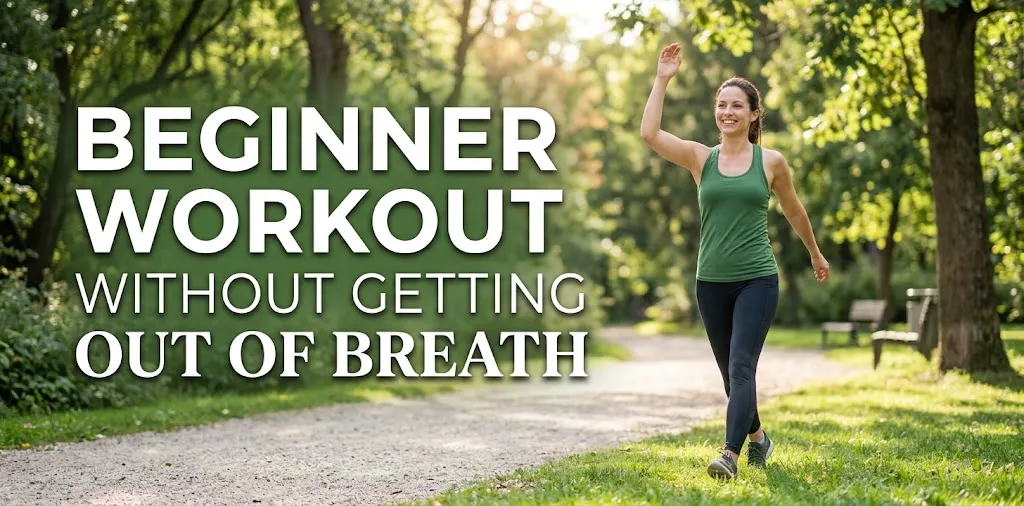
If exercise leaves you gasping for air after a few minutes, you do not have to push harder. For many beginners, the better approach is to start with low-impact movements, keep the pace comfortable, and build endurance gradually. A workout should challenge you without making you feel like you cannot catch your breath.
How to Exercise Without Getting Out of Breath
A beginner workout can help you build fitness without leaving you severely winded. Start with low-impact movements such as easy walking, marching in place, chair exercises, gentle squats, and slow step-ups. Keep the intensity low enough that you can speak in short sentences while exercising. This “talk test” is a simple way to judge exercise intensity.
The goal is not to avoid every increase in breathing. Your breathing may become faster as you move, which is normal. The goal is to avoid pushing yourself so hard that you cannot comfortably talk or recover.
A Simple 15-Minute Beginner Workout
You can do this workout at home with no equipment. Keep your movements slow and controlled, and take extra rest whenever you need it.
| Exercise | Time | Intensity |
|---|---|---|
| Easy marching in place | 2 minutes | Very easy |
| Shoulder rolls | 1 minute | Easy |
| Chair squats | 2 minutes | Easy |
| Side steps | 2 minutes | Easy |
| Wall push-ups | 2 minutes | Easy |
| Standing knee lifts | 2 minutes | Easy |
| Easy walking or marching | 2 minutes | Easy |
| Gentle cool-down | 2 minutes | Very easy |
You do not need to complete every movement continuously. For example, you can exercise for 30–60 seconds, rest, and then continue.
1. March in Place
Stand comfortably and slowly lift one foot at a time. Swing your arms naturally.
Keep your steps small. If your breathing becomes noticeably heavier, slow down or pause.
2. Chair Squats
Stand in front of a sturdy chair with your feet about hip-width apart. Slowly bend your knees and hips as if you are going to sit down, then stand back up.
You do not need to touch the chair on every repetition. Use it for support if needed.
3. Side Steps
Step to the right, bring your other foot beside it, and then repeat on the left.
This is a simple way to keep moving without jumping or running.
4. Wall Push-Ups
Place your hands against a wall around chest height. Step back slightly, bend your elbows, and slowly bring your chest toward the wall. Push yourself back to the starting position.
Wall push-ups are much easier to control than floor push-ups, making them useful when you are just starting.
5. Standing Knee Lifts
Hold the back of a sturdy chair if you need support. Slowly lift one knee, lower it, and switch sides.
Do not try to lift your knees as high or as quickly as possible. A comfortable range of motion is enough.
How Hard Should a Beginner Workout Feel?
Use the talk test instead of trying to exercise as hard as possible.
At a moderate intensity, you should generally be able to talk but not sing. If you can only say a few words before stopping to breathe, the activity is closer to vigorous intensity.
For someone who gets out of breath easily, staying below that moderate-intensity threshold at first may feel more comfortable.
A useful rule is:
- Too easy: You barely notice that you are moving.
- Comfortable: You can talk normally and feel that your body is working.
- Challenging: You can talk, but your breathing is noticeably faster.
- Too hard for this goal: You struggle to speak because you are trying to catch your breath.
You can increase the challenge later. There is no need to prove your fitness during your first workout.
How to Control Your Breathing During Exercise
Try to keep your breathing steady instead of holding your breath.
For strength movements such as squats or wall push-ups, breathe naturally throughout the movement. A simple approach is to exhale during the harder part and inhale as you return to the starting position.
If you notice yourself holding your breath, stop for a moment and reset.
Also avoid rushing between exercises. Taking 30–60 seconds to recover can make a beginner workout much more manageable.
The Best Exercises If You Get Winded Easily
Some exercises are easier to control than others. When your main goal is to exercise without becoming very short of breath, choose movements where you can easily slow down.
Good options include:
- Easy walking
- Walking on a treadmill at a comfortable pace
- Marching in place
- Side steps
- Chair squats
- Wall push-ups
- Gentle standing knee lifts
- Light stationary cycling
- Water walking
- Gentle mobility exercises
You may want to avoid starting with burpees, sprinting, jump squats, jumping jacks, or fast HIIT circuits if those movements quickly make you breathless. High-intensity workouts can be useful for some people, but they are not required to begin building fitness.
How Long Should a Beginner Exercise?
Start with an amount of activity you can complete comfortably and repeat consistently.
For example, if 15 minutes feels like too much, begin with 5–10 minutes. You can divide activity into smaller sessions during the day rather than trying to complete one long workout.
A simple progression could look like this:
| Week | Suggested approach |
|---|---|
| Week 1 | 5–15 minutes of easy movement, 3–5 days |
| Week 2 | 10–15 minutes, 3–5 days |
| Week 3 | 15–20 minutes, 3–5 days |
| Week 4 | Gradually add time or slightly increase your pace |
This is a flexible example, not a requirement. If a week feels difficult, repeat it instead of increasing the workload.
How to Progress Without Getting Breathless
The easiest mistake to make is increasing everything at once.
Instead, change only one factor at a time.
You could:
- Exercise for a few more minutes.
- Add another workout day.
- Walk slightly faster.
- Reduce your rest periods a little.
- Move to a slightly harder exercise.
For example, if you currently walk for 10 minutes comfortably, you might increase the walk to 12–15 minutes before trying to walk faster.
Your body needs time to adapt. Gradual progress is usually more sustainable than going from very little activity to exhausting workouts.
What to Do If You Get Out of Breath During a Workout
Do not try to “push through” severe breathlessness.
Slow down or stop and allow your breathing to settle. You can sit or stand comfortably, take your time, and resume only if you feel ready.
If the same activity repeatedly makes you extremely breathless, make it easier. Reduce the speed, shorten the session, increase your rest periods, or choose a lower-impact movement.
If you experience chest pain, fainting, severe dizziness, unusual weakness, or severe or unexpected shortness of breath, stop exercising and seek appropriate medical care. If you have a medical condition, have been inactive for a long time, or are unsure whether exercise is appropriate for you, talk with a healthcare professional before starting a new workout program.
Two Beginner Examples
Example 1: Someone Who Has Been Inactive
Suppose you have spent several months mostly sitting and now want to exercise. A 30-minute cardio workout may feel overwhelming.
Instead, start with 10 minutes:
- 2 minutes of easy walking
- 2 minutes of side steps
- 2 minutes of chair squats and wall push-ups
- 2 minutes of easy marching
- 2 minutes of slow walking
If you finish while still feeling comfortable, that is a successful workout.
Example 2: Someone Who Gets Winded on Stairs
If one flight of stairs leaves you breathing heavily, running or jumping is probably not the best starting point.
Try flat-ground walking at a comfortable pace. Once you can walk longer without becoming excessively winded, gradually increase your walking time before adding hills or stairs.
Common Mistakes That Make Beginner Workouts Feel Too Hard
Starting Too Fast
Moving quickly can raise your breathing rate before your body has time to settle into the workout. Start slowly and increase the pace only if you still feel comfortable.
Choosing Advanced “Beginner” Workouts
Some workouts labeled beginner still include jumping, fast intervals, or demanding bodyweight exercises. Beginner does not mean that every beginner can perform the same movements.
Choose exercises that match your current fitness level.
Skipping the Warm-Up
Going directly from sitting to vigorous movement can make the first few minutes feel much harder.
Start with easy walking, marching, or gentle movement for several minutes before increasing the pace.
Trying to Finish at Any Cost
You do not get extra credit for completing a workout that makes you feel miserable.
A shorter workout that you can repeat several times a week is more useful than one exhausting session followed by several days of inactivity.
When Getting Out of Breath May Need Medical Attention
Being somewhat short of breath during exercise can be normal, especially when your body is not used to physical activity. However, severe or unusual breathing problems should not simply be blamed on being “out of shape.”
Talk with a healthcare professional if you regularly become unusually short of breath with very light activity or if your breathing problems are new, worsening, or interfering with normal activities.
Get urgent medical help for serious symptoms such as severe breathing difficulty, chest pressure or pain, fainting, or other symptoms that feel like an emergency.
Frequently Asked Questions
Can I get fit without doing hard cardio?
Yes. You can build your activity level with walking, low-impact cardio, strength exercises, and other movements that do not leave you severely breathless. As your fitness improves, you can gradually increase the intensity if you want to.
Why do I get out of breath so quickly when I exercise?
Being new to exercise or returning after a long break can make activity feel harder. However, breathlessness can have many possible causes, so persistent or unusually severe shortness of breath should be discussed with a healthcare professional.
How can I improve my stamina without getting exhausted?
Start with short, comfortable sessions and increase the duration gradually. Use the talk test to keep your effort under control, and allow enough recovery between workouts. Moderate activity should generally let you talk even though you cannot comfortably sing.
Start Easier Than You Think
A beginner workout does not need to leave you sweaty, exhausted, or gasping for air to be worthwhile. Start with movements you can control, keep the pace comfortable, and build your exercise time gradually.
The best first workout is one you can finish and feel ready to repeat. For your next session, try 10–15 minutes of easy walking, marching, chair squats, and wall push-ups while using the talk test to control your pace.