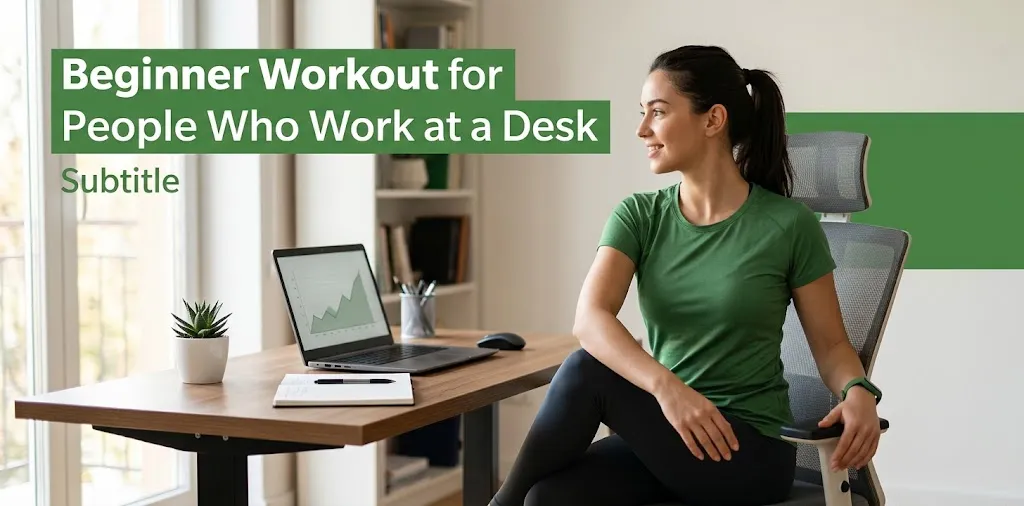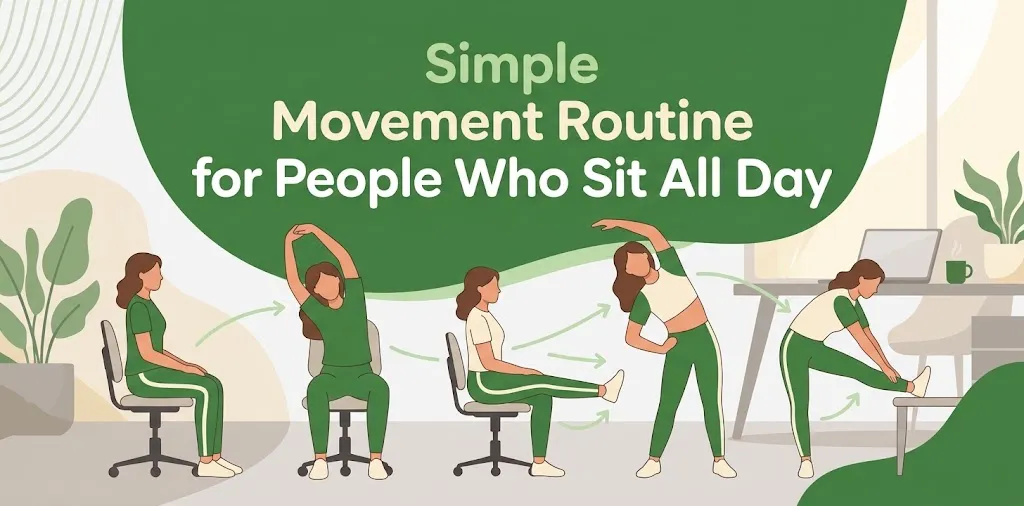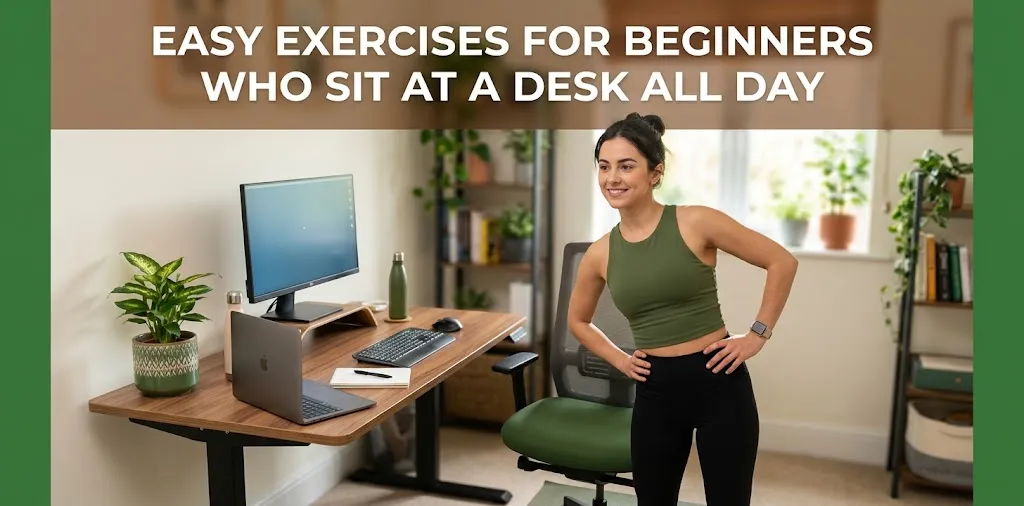
If you spend most of your workday sitting, you do not need a gym or a long workout to start moving more. Simple exercises such as chair squats, seated leg extensions, calf raises, desk push-ups, shoulder rolls, and gentle stretches can break up long periods of sitting. The goal is to start comfortably, move regularly, and gradually build toward a more active routine.
Why Desk Workers Need More Movement
A desk job can make it easy to stay in the same position for hours. You may sit through a morning of emails, meetings, and computer work, then spend your evening sitting again.
Long periods of sitting can contribute to stiffness and discomfort, especially around the neck, shoulders, upper back, hips, and lower back. Simple stretches and movement breaks can help you change positions and stay more active throughout the day.
U.S. physical activity guidelines encourage adults to move more and sit less. Adults should work toward at least 150 minutes of moderate-intensity aerobic activity each week plus muscle-strengthening activity on at least two days. Even smaller amounts of activity are better than none.
The goal is not to avoid sitting completely. Instead, try to interrupt long periods of sitting with short periods of movement.
The Best Beginner Exercises for Desk Workers
You can use these exercises at home, in an office, or during a short break from your computer. Start with a few movements that feel comfortable instead of trying to do everything at once.
1. Shoulder Rolls
Shoulder rolls are one of the easiest ways to loosen up after sitting at a computer.
How to do them:
- Sit or stand tall.
- Relax your arms beside your body.
- Slowly lift your shoulders toward your ears.
- Roll them backward and down.
- Repeat 8–10 times.
- Reverse the direction and repeat.
Move slowly rather than making large, fast circles.
2. Neck Turns
Looking at a screen for hours can leave your neck feeling stiff.
How to do them:
- Sit upright with both feet on the floor.
- Keep your shoulders relaxed.
- Slowly turn your head to the right.
- Return to the center.
- Slowly turn to the left.
- Repeat 5–8 times on each side.
Do not force your neck into a deep stretch. The movement should feel gentle.
3. Seated Leg Extensions
This simple movement works your thigh muscles without requiring you to leave your chair.
How to do them:
- Sit near the front of a stable chair.
- Keep one foot on the floor.
- Slowly straighten the other leg.
- Pause briefly.
- Lower your foot back down.
- Repeat 8–12 times.
- Switch legs.
Keep the movement controlled instead of kicking the leg outward.
4. Seated Calf Raises
Calf raises are easy to perform while sitting and require no equipment.
How to do them:
- Sit upright with both feet flat.
- Keep your toes on the floor.
- Lift your heels slowly.
- Pause for a moment.
- Lower your heels.
- Repeat 10–15 times.
As you become stronger, you can perform calf raises while standing and holding a stable surface for balance.
5. Chair Squats
Chair squats are a useful beginner exercise because the chair gives you a clear target and can help you control the movement.
How to do them:
- Stand in front of a sturdy chair.
- Place your feet about shoulder-width apart.
- Push your hips back as if you are going to sit.
- Bend your knees while keeping your chest comfortably upright.
- Lightly touch the chair or stop just above it.
- Stand back up.
- Start with 6–10 repetitions.
Use a stable chair that does not roll. If you have balance problems, keep a sturdy surface nearby for support.
6. Wall or Desk Push-Ups
Traditional floor push-ups can be difficult for beginners. A wall or sturdy desk lets you start with a lighter version.
Wall version:
- Stand facing a wall.
- Place your hands on the wall around shoulder height.
- Step your feet back slightly.
- Bend your elbows and bring your chest toward the wall.
- Push yourself back.
- Repeat 6–12 times.
As this becomes easy, you can progress from wall push-ups to desk or countertop push-ups.
7. Seated Knee Lifts
This is a gentle way to get your hips and core involved while remaining in your chair.
How to do them:
- Sit tall with your feet flat.
- Lift one knee a few inches.
- Lower it slowly.
- Lift the other knee.
- Continue alternating for 30–60 seconds.
Keep your torso upright instead of leaning backward.
8. Chest Stretch
Your chest and shoulders can feel tight after spending hours reaching toward a keyboard.
How to do it:
- Sit or stand tall.
- Move your arms gently behind you.
- If comfortable, bring your hands together.
- Open your chest without arching your lower back.
- Hold for about 10–30 seconds.
- Relax and repeat once or twice.
You should feel a mild stretch, not pain.
9. Overhead Reach
This movement gives your upper body a simple change of position.
How to do it:
- Sit or stand tall.
- Raise one arm overhead.
- Reach gently upward.
- Lower it.
- Repeat with the other arm.
- Continue for 20–30 seconds.
You can also reach slightly to the opposite side if that feels comfortable.
10. Standing March
When you have a little more space, stand up and march in place.
How to do it:
- Stand tall near your desk.
- Lift one knee.
- Lower it.
- Lift the other knee.
- Continue at a comfortable pace for 30–60 seconds.
This is an easy way to turn a sitting break into light activity.
A Simple 5-Minute Desk Exercise Routine
You do not need to complete a full workout every time you get up. A short routine can be enough to interrupt a long sitting period.
| Exercise | Time or Reps |
|---|---|
| Shoulder rolls | 10 reps |
| Seated leg extensions | 8 each leg |
| Chair squats | 8 reps |
| Wall push-ups | 8 reps |
| Calf raises | 10 reps |
| Standing march | 30 seconds |
| Chest stretch | 20 seconds |
Move at an easy pace. If five minutes feels like too much at first, choose only two or three exercises.
The purpose of this routine is to make movement easier to fit into your workday, not to replace every other form of exercise.
How Often Should You Exercise at a Desk?
There is no single required schedule for desk exercises. The most useful approach is to avoid letting several hours pass without moving.
For example, you could:
- Do shoulder rolls after finishing a meeting.
- Stand and stretch between tasks.
- Walk around while making a phone call when practical.
- Do a few chair squats during a longer break.
- Take a short walk at lunch.
- Use stairs instead of an elevator when appropriate.
- Set a reminder to stand or move during the workday.
You do not need to follow a perfect timer. The main idea is to avoid staying in one position for too long.
A Beginner Workday Movement Plan
If you sit for most of an eight-hour workday, try building movement into normal tasks instead of waiting for a dedicated workout.
| Part of the Day | Simple Movement |
|---|---|
| Start of work | 2–3 minutes of shoulder rolls and gentle stretches |
| Mid-morning | Stand, walk, and do a few chair squats |
| Before lunch | 5-minute beginner desk routine |
| Afternoon | Short walk or standing movement break |
| Late afternoon | Wall push-ups and calf raises |
| After work | Walk, bike, or another activity you enjoy |
This approach makes exercise feel less like another task on your schedule.
How to Progress When These Exercises Become Easy
Beginners often make one mistake: trying to increase everything at once.
Instead, progress gradually.
For example, if you can comfortably perform 8 chair squats, try 10 next time. When 10 becomes easy, add another small increase or use a slightly harder variation.
You can progress by:
- Adding a few repetitions.
- Holding a movement for slightly longer.
- Moving more slowly.
- Adding another set.
- Switching from wall push-ups to desk push-ups.
- Moving from seated calf raises to standing calf raises.
- Taking longer or faster walks.
The goal is steady progress rather than exhausting yourself.
Desk Exercises Are Not a Replacement for Regular Exercise
Desk exercises are useful, but they should be viewed as one part of an active lifestyle.
For overall health, adults should work toward at least 150 minutes of moderate aerobic activity each week and muscle-strengthening activity on at least two days. The weekly activity can be divided into smaller periods rather than completed in one long session.
A brisk walk, cycling, swimming, dancing, fitness class, or another activity you enjoy can provide aerobic exercise outside your desk routine.
For example, someone who sits at a computer from 9 a.m. to 5 p.m. might use short movement breaks during work and take a 20–30 minute walk after work. Those activities serve different purposes and can work together.
Common Mistakes Beginners Should Avoid
Trying to Do Too Much on the First Day
If you have been inactive, a long or intense workout may leave you extremely sore and make it harder to exercise again.
Start with a few easy movements and build gradually.
Exercising Through Pain
A gentle stretch or muscle effort can feel challenging, but sharp, severe, or unusual pain is a reason to stop.
Do not assume pain means an exercise is working.
Using an Unstable Chair or Desk
A rolling office chair is not a good choice for chair squats or other movements that require stability.
Make sure the surface you use for support is sturdy before doing desk or wall exercises.
Treating Desk Exercises as Your Entire Fitness Plan
Five minutes of movement is useful, but it does not have to be the only exercise you do.
Add walking and other activities that work your heart and major muscle groups.
Waiting Until You Have Free Time
For many desk workers, free time never seems to appear.
Instead, connect movement to things you already do: finishing a meeting, taking a phone call, getting water, or starting a new work task.
How to Make Desk Exercise a Habit
The easiest routine is usually the one that fits naturally into your workday.
Try these strategies:
- Keep your exercise simple.
- Put a reminder on your computer or phone.
- Keep comfortable shoes available for walking breaks.
- Stand during appropriate phone calls.
- Take the longer route to the restroom or break area.
- Invite a coworker to take a short walk.
- Keep track of how many movement breaks you complete.
- Focus on consistency rather than perfection.
Choose activities that fit your abilities and preferences. Activities you enjoy are often easier to maintain over time.
When to Get Medical Advice Before Exercising
Most healthy adults can begin with light-to-moderate physical activity, but your starting point may need to be different if you have a medical condition, disability, significant mobility limitation, or another health concern.
If you have a chronic health condition or another concern about exercising, consider talking with a health professional about appropriate activities and intensity.
You should also stop an exercise that causes significant pain, dizziness, unusual shortness of breath, or another concerning symptom and seek appropriate medical guidance.
Frequently Asked Questions
What is the easiest exercise to do at a desk?
Shoulder rolls, seated leg extensions, calf raises, and gentle stretches are among the easiest options for beginners. They require little space and can be performed without changing clothes or using equipment.
How often should I get up from my desk?
There is no single interval that everyone must follow. A practical approach is to take frequent movement breaks rather than staying seated for several hours, with activities such as walking, stretching, or standing built into your workday.
Can desk exercises help me get in shape?
They can help you add movement and strength work to a sedentary workday, but they should not be your only form of exercise. For overall fitness, gradually add regular walking, aerobic activity, and muscle-strengthening exercises to your routine.
Start With Five Minutes, Not Perfection
If you sit at a desk all day, you do not need to transform your routine overnight. Start with five minutes of easy movement, repeat it during your workday when practical, and gradually add walking and strength exercises outside your desk breaks.
The best beginner routine is one you can actually repeat. Pick three exercises today—such as chair squats, wall push-ups, and calf raises—and make them part of your normal workday.